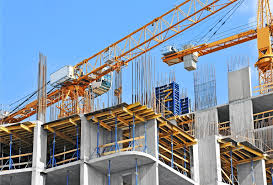
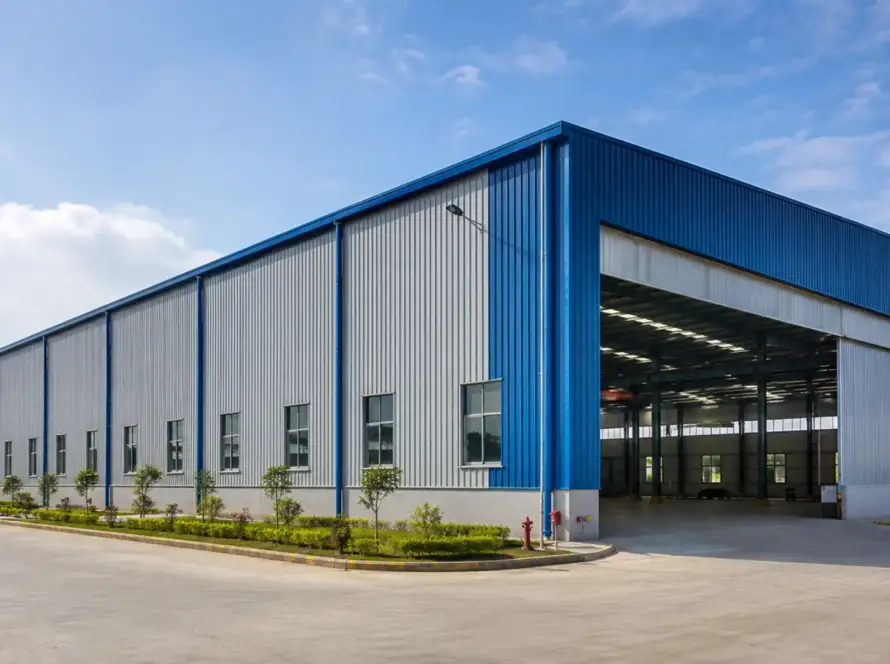
Visakhapatnam is a port city and an industrial city rolled into one, and that’s precisely why Pre-Engineered Building Solutions in Visakhapatnam can’t just follow a standard PEB playbook. On one side you’ve got salt-heavy port air chewing away at exposed steel. On the other, heavy industrial loads that most inland designs were never built to carry. A shed that holds up fine in Hyderabad won’t last the same way five kilometres from the harbour here. So let’s get into what actually matters if you’re looking at Pre-Engineered Building Solutions in Visakhapatnam — corrosion, load engineering, what really drives cost, the compliance side, and how to pick a vendor without just comparing numbers on a page.
Why Pre-Engineered Building Solutions in Visakhapatnam Need a Different Approach
Vizag isn’t just “a coastal city” in the vague sense people throw around. It’s a working port handling serious cargo volumes, home to the Visakhapatnam Steel Plant and refineries running around the clock, active shipyards doing marine fabrication work, a naval base, and a pharma sector that’s quietly expanded over the last several years. Each of those brings a different headache — salt corrosion here, machinery vibration there, hazardous storage rules somewhere else, operations that basically never stop. Take a PEB spec built for Nagpur or some inland Andhra district and drop it here, and it’ll start giving trouble within a few years, because nobody bothered to design for the salt exposure or the actual loads the site carries. That’s the part most vendors skip past, and it’s why Pre-Engineered Building Solutions in Visakhapatnam really are their own thing, not a rebadged inland design with a different pin on the map.
The Corrosion Problem Nobody’s Talking About
Why Salt Air Breaks Down Standard Steel Coatings
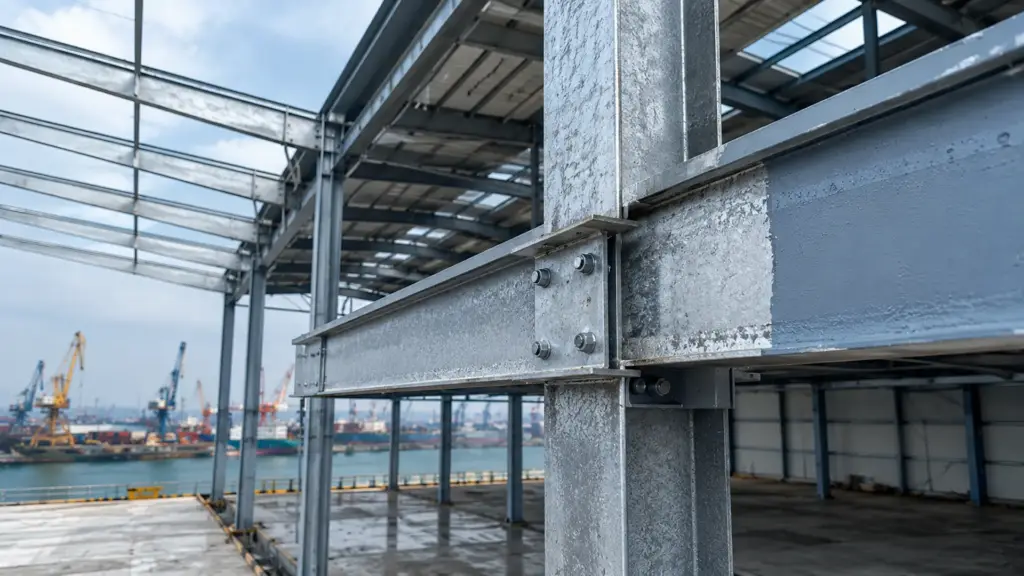
Here’s the mechanism, in plain terms: salt-spray corrosion. Tiny salt particles land on exposed steel, moisture mixes with the chloride, and the coating starts breaking down from the inside out — well before there’s anything visible on the surface. A decent primer-and-paint job might get you 15 to 20 years inland, no complaints. Put the exact same coating a couple of kilometres from Vizag’s coast and you’re looking at visible corrosion in maybe 3 to 5 years, roof sheeting and purlins usually going first. The frustrating part is you don’t see it coming. By the time it’s obvious, it’s already structural. This is honestly the one thing that separates decent Pre-Engineered Building Solutions in Visakhapatnam from the ones that quietly fall apart within a few short years.
Coating Systems Compared — Galvalume vs. Hot-Dip Galvanizing vs. Marine-Grade Epoxy
Three systems show up again and again in this market, and no, they’re not the same thing wearing different names.
| Coating Type | Protection Level | Relative Cost | Typical Lifespan | Best Use Case |
|---|---|---|---|---|
| Galvalume (aluminium-zinc alloy) | Good general resistance | Moderate | 15-20 years in mild exposure | Cladding away from direct salt spray |
| Hot-Dip Galvanizing | Strong, sacrificial zinc layer | Moderate-High | 20-25+ years, even in humid coastal air | Structural framing near the port |
| Marine-Grade Epoxy (multi-coat) | Highest, usually paired with zinc primer | Highest | 25+ years with upkeep | Direct salt-spray zones, refinery sites |
Most projects that actually sit near the port don’t bank on just one of these. Hot-dip galvanized steel runs through the main structure, a marine-grade epoxy topcoat goes on whatever takes the worst beating, and Galvalume handles the cladding further from the water. I’ll be honest — coating everything in epoxy sounds safer, but it’s usually overspend. Put the money where the exposure is worst and you get better value out of the same budget.
What to Ask Your PEB Vendor About Coating Specs
Before you sign off on anything, push for real answers on:
- Coating thickness in microns — not just a coating name on a spec sheet
- Whether the spec actually accounts for your site’s distance from the coast, or it’s their default inland offering
- Salt-spray test certificates, not a vague line about “corrosion resistance”
- Whether the warranty covers coating performance specifically, or just the structure
Built for Cargo, Not Just Shelter — Port-Specific Engineering
Overhead Crane Compatibility & Heavy Load Design
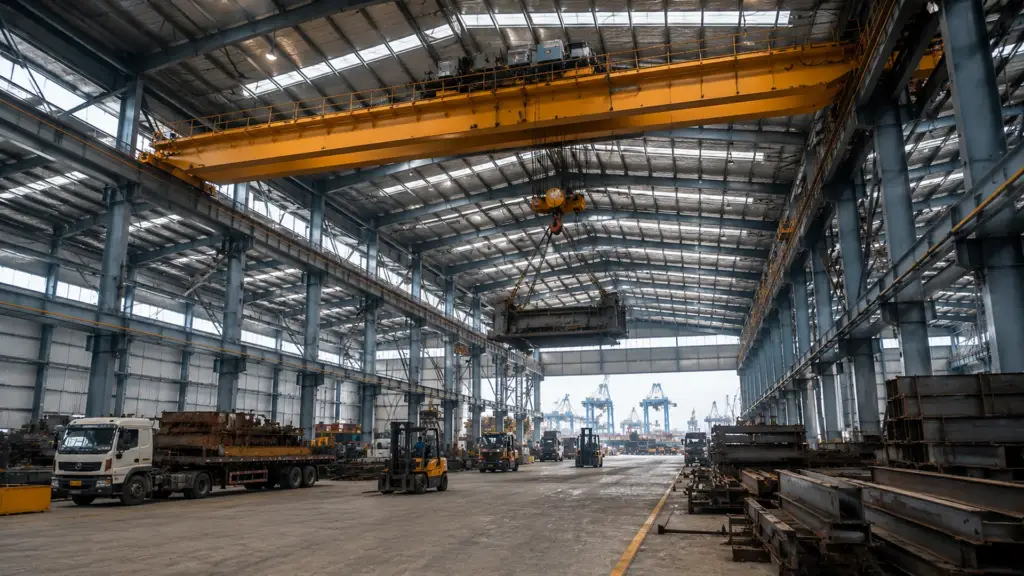
Cranes change the whole design, full stop — column spacing, bracket placement, even the grade of steel used in the crane beams shifts. You can’t tack this on after the fact. If a building wasn’t designed with crane loads in mind from the start, retrofitting later gets expensive quickly, and sometimes it’s just not workable. If there’s even a chance you’ll need overhead crane support down the road, that has to get decided at the design stage, not after the shed is standing.
Clearances for Heavy Vehicle Movement & Cargo Handling
Trailers, forklifts, cargo equipment — all of it needs space to move. That means wider bays, taller eaves, doors sized for containers instead of the standard warehouse rollup. Miscalculate these dimensions and you either pay for rework later or end up with a building that can’t actually handle the traffic it was meant for.
Hazardous Material Storage & Zoning Considerations
With the volume of petrochemical and steel cargo moving through this city, plenty of sheds need to plan around hazardous storage from day one — separate zoning, fire-rated partitions, proper ventilation, spill containment where needed. None of that comes standard with a basic PEB order. It gets specified based on what’s actually stored inside, in line with the applicable safety rules.
High-Bay Clear-Span Requirements
Heavy operations need open floor space, no columns getting in the way of equipment or stock movement. PEB is genuinely good at this — clear spans of 30 metres or more without a single interior column, in the right cases. But that span still needs to be engineered against the real load and height the site needs. It doesn’t just come free with the package.
Regulatory & Compliance Requirements in Andhra Pradesh
Every PEB project here has to work within Andhra Pradesh’s building code and the National Building Code of India, both covering structural safety, fire safety, and occupancy classification. Seismic design isn’t something you can skip either — Vizag sits in a moderate seismic zone, and that has to feed into the load calculations, particularly for taller structures or anything carrying a crane.
Sites near or inside port limits usually need clearance from the Visakhapatnam Port Authority, or whichever maritime body applies, before construction can even begin — especially if the site touches port logistics or restricted zones. Projects dealing with hazardous materials, large-scale processing, or major land-use changes might also need environmental clearance from the state or central pollution control board. These requirements shift depending on the scale and location of the project, so it’s worth confirming exactly what you need with local authorities early on. Finding out mid-construction is the expensive way to learn this.
What Actually Drives the Cost of Pre-Engineered Building Solutions in Visakhapatnam
A flat ₹/sq ft number doesn’t tell you much on its own, honestly. Real cost comes down to four things.
Foundation Costs & Coastal Soil Conditions
Soil near the Vizag coast tends to be softer and sandier than what you’d find inland, which can mean deeper foundations, piling, or soil stabilization before a single steel column goes up. Early soil testing is what determines this, and it can shift the foundation budget quite a bit depending on the site.
Steel Tonnage & Design Load Factors
How much steel a project needs — and a large part of the cost — comes down to span width, crane loads, wind loads, and seismic factors. A plain storage shed needs a fraction of the steel per square foot compared to a crane-supported structure carrying real industrial loads.
Cladding, Insulation & Coating Upgrades
Moving from basic Galvalume to marine-grade epoxy, or adding insulation for temperature-sensitive storage, pushes the upfront number up. But that spend buys years of extra life in a corrosive environment, which is usually worth it.
Site Accessibility & Port-Adjacent Logistics
Sites close to the port, or stuck inside congested industrial zones, often mean higher transport costs and access restrictions during construction. Easier road access usually keeps mobilization costs down.
A realistic estimate ties all four of these together instead of throwing out a single figure. A high-load, coastal-soil, port-adjacent project with premium coatings is always going to cost more than a basic inland shed at the same square footage — and any quote that pretends otherwise isn’t really a quote.
PEB vs. RCC vs. Conventional Steel — Which Fits Port & Industrial Projects?
| Factor | PEB | RCC (Reinforced Concrete) | Conventional Steel |
|---|---|---|---|
| Construction Timeline | Fastest — weeks to a few months | Slowest — months to over a year | Moderate |
| Cost per sq ft (relative) | Low to moderate | Moderate to high | Moderate to high |
| 10-Year Maintenance Cost | Low, with correct coastal coating | Low, but reinforcement corrosion is a known coastal issue | Moderate to high without proper coating |
| Coastal Durability | High, with correct coating spec | Moderate | Depends on coating quality |
| Suitability for Heavy Industrial Loads | High — built for crane loads and large spans | High, but heavier and slower to modify | High, but less standardized |
For most port and industrial work around Vizag, PEB comes out ahead on speed and span flexibility — as long as the coating and load engineering are actually done right for coastal conditions, which is exactly the part vendors like to shortcut. RCC still has its place where fire resistance or specific load-bearing walls aren’t up for debate, and conventional steel makes sense for highly custom builds that don’t fit a standard mould. Really, the decision comes down to how much timeline pressure you’re under, what loads you’re dealing with, and how much long-term maintenance you’re willing to take on.
What a Typical Port-Adjacent PEB Project Looks Like
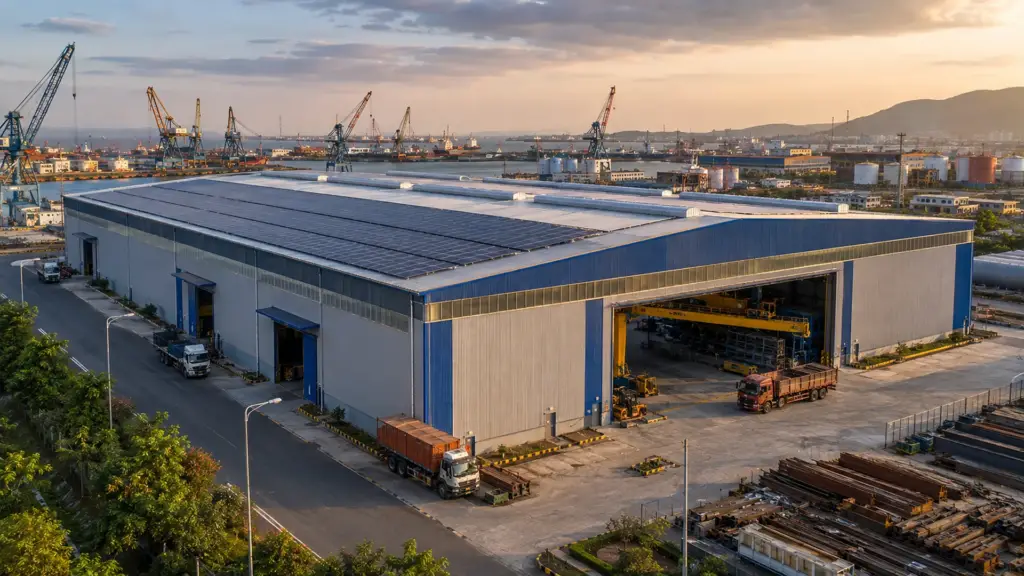
Take a mid-sized industrial shed built for cargo storage and light processing near the Vizag port belt — a fairly typical scenario for the kind of project we’ve been discussing. The site sat around two kilometres from the coastline. Soil testing came back showing sandier, less stable ground than the initial survey had suggested, so the foundation plan shifted to a pile-supported system before construction even started.
The build needed a 25-metre clear span — enough room for forklifts and trailers to move without interior columns in the way — plus provision for an overhead crane down the line. So the column and beam design got engineered around that crane load right from the start, even though the crane itself wasn’t going in immediately. Given how close the site sat to the coast, the project used hot-dip galvanized primary steel with a marine-grade epoxy topcoat on the most exposed members, and Galvalume cladding on the roof and walls where exposure was lighter.
From foundation to handover, the whole thing took a little over four months — slower than a typical inland PEB timeline because of the extra soil work, but still well ahead of what an RCC build would’ve needed. What they ended up with was a structure sized for current cargo needs, but with enough structural headroom to add a crane later without touching the frame. That’s really the detail that matters: the gap between a building that serves a port operation for a decade and one that needs expensive rework in a few years usually comes down to decisions made long before the first foundation pour.
Choosing the Right Partner for Pre-Engineered Building Solutions in Visakhapatnam
A lot of PEB vendors claiming to “serve” Andhra Pradesh are really just swapping the city name on the same generic proposal, with zero actual port or coastal engineering behind it. Before committing to a provider of Pre-Engineered Building Solutions in Visakhapatnam, it’s worth checking:
- Local manufacturing or fabrication proximity — closer facilities mean lower transport costs and faster steel delivery
- Coating certifications — ask for actual documented salt-spray test results, not marketing language
- Engineering documentation — a vendor worth hiring will hand you site-specific structural drawings and load calculations, not a generic template
- Past port or industrial project experience — ask for specifics on similar coastal or industrial builds they’ve actually completed
- Compliance track record — check whether they know AP building codes, seismic requirements, and port authority clearance processes, since gaps here can stall a project for months
If a vendor can answer these straight, without dodging, that’s usually a good sign they understand what building near Vizag’s port actually takes.
FAQs
Most run a few weeks to a few months from foundation to handover, though coastal soil issues or crane-load engineering can push that timeline out compared to a standard inland project.
Yes — but only when the coating system and structural design are actually specified for coastal exposure. A generic inland spec won’t hold up; the coating and load design need to match what the site is really dealing with.
PEB usually comes in cheaper per square foot than RCC, mostly thanks to faster construction and lighter foundation needs, though that gap shrinks once premium coatings or heavier load engineering get added in.
Yes. Regular checks on coatings, especially around joints and exposed structural members, catch corrosion before it becomes a structural issue. How often depends on the coating system used and how close the site is to the coastline.
Get a Site-Specific Assessment
No two port-adjacent sites around Vizag share the same soil, load requirements, or exposure level, so a generic quote won’t really tell you much. If you’re ready to move forward with Pre-Engineered Building Solutions in Visakhapatnam, request a consultation and we’ll work through the actual engineering and coating requirements for your site before you’re locked into a number.