Most content about green building certification either talks about offices and malls, or it talks about steel buildings in a general, borrowed-from-the-US kind of way. Almost nobody puts the two together and asks the question a factory owner in Gujarat actually has: does green building certification (IGBC/LEED) for PEB factories make sense for your project, and what does it really take to get there?
This guide answers that directly — what the IGBC Green Factory Buildings rating actually involves, what to ask your PEB manufacturer before you commit to certification, and who’s responsible for what once the process starts.
Does Your Factory Actually Need Green Building Certification (IGBC/LEED)?
Before getting into checklists and ratings, it’s worth asking the honest question first: do you actually need this?
If your factory supplies export markets, works with multinational clients, or sits under a parent company that reports on ESG or sustainability goals, certification often isn’t optional anymore — it’s becoming part of doing business. Buyers and auditors in these categories increasingly want to see it on paper.
If your factory is purely domestic-facing, with no client pressure and no compliance requirement pushing you toward it, certification is more of a choice than a necessity. That doesn’t mean it has no value — better insulation and smarter daylighting genuinely cut your power bills regardless of whether you certify — but you don’t need a rating plaque on the wall to get those benefits. It’s worth being clear-eyed about this before spending time and money chasing a certificate nobody’s asking you for.
IGBC vs LEED — Which One Fits a Gujarat Factory?
For most Indian manufacturing units, IGBC is the more practical route when it comes to green building certification (IGBC/LEED) for PEB factories. It’s built around Indian climate conditions, Indian construction practices, and Indian regulatory requirements, so the credits you’re chasing actually match how a factory here is built and run. LEED, on the other hand, carries more international recognition — it matters more if you’re trying to impress a global tenant, an overseas buyer, or a parent company based abroad that specifically asks for LEED.
In short: if your priority is local relevance and a smoother certification process, IGBC usually makes more sense. If international brand recognition is the goal, LEED is worth the extra effort and cost.
Typical Cost & Timeline for a Mid-Size Industrial Shed
Certification costs for factory buildings are usually lower than what you’d see quoted for large commercial or office projects, since a factory shed is a simpler structure with fewer interior systems to document. That said, costs vary a lot depending on the size of your facility, how far along your design already is, and which consultant you hire.
The safest approach is to get a direct quote from an IGBC-accredited consultant based on your actual factory’s built-up area and current design stage, rather than going by a number you saw for a commercial building — those aren’t comparable. On timeline, expect the process to run alongside your construction schedule rather than after it, since documentation needs to be built in from the design stage onward.
Gujarat-Specific Incentives Worth Knowing
Some Indian states offer incentives for green-rated buildings, such as relaxations in floor area ratio or reductions in property tax, as part of their industrial or urban development policies. Whether Gujarat offers something similar for your specific project depends on your location, the applicable municipal or industrial policy, and how it’s classified — this is worth checking directly with your local development authority or your certification consultant before you count on any specific benefit. Don’t take a general incentive you’ve read about online as guaranteed for your factory without confirming it locally.
Inside the IGBC Green Factory Buildings Rating System
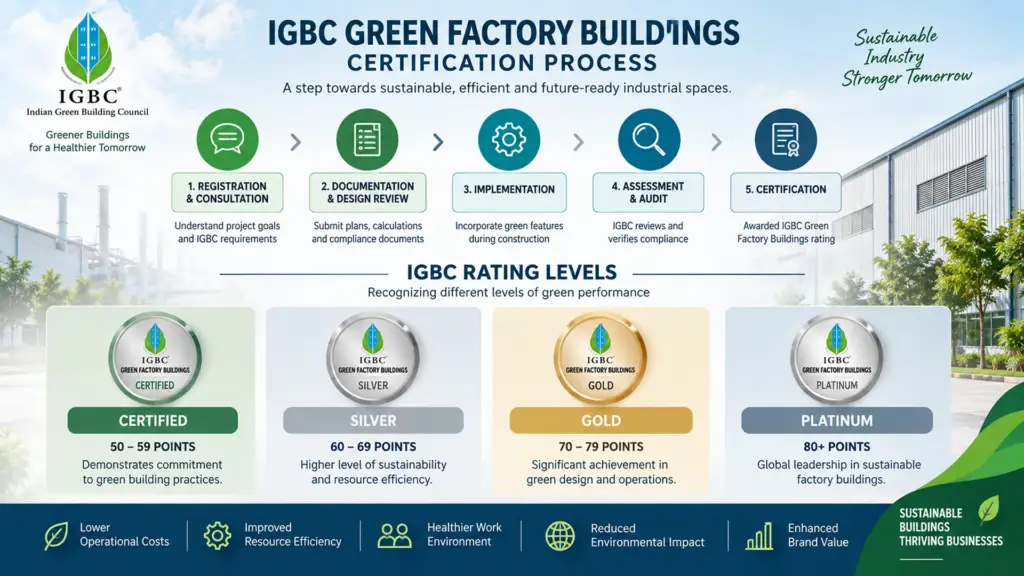
This is the part almost nobody explains clearly, so let’s go through it properly. Understanding this system is really the heart of green building certification (IGBC/LEED) for PEB factories, since it’s the framework your entire building gets measured against.
How the Checklist and Points System Works
IGBC’s Green Factory Buildings rating works on a checklist system. Your project team goes through the checklist and identifies which credits are realistically achievable for your building, then works toward earning enough points across those credits. Importantly, there are also mandatory requirements built into the system — these aren’t optional extras you can skip if you’re short on points elsewhere. Your project has to meet every mandatory requirement regardless of how many bonus credits you rack up elsewhere. This is different from just “scoring high” — you can’t trade away the non-negotiables.
Certification Levels and Validity
Based on the total credits your project earns, it gets awarded one of several rating levels — moving up from a base “Certified” recognition through higher tiers as more credits are achieved. One detail that catches people off guard: the certification isn’t permanent. It’s valid for three years from the date it’s issued, after which the building needs to go through renewal to maintain its rating. If you’re budgeting for certification, it helps to factor in that this isn’t a one-time cost — it’s something you’ll need to revisit.
Categories That Apply Specifically to Factory Buildings
For a factory, the credits that matter most usually sit around energy performance, water use and management, and site and material choices — the practical, operational side of running an industrial building, rather than things like occupant wellness features you’d see weighted more heavily in office-focused ratings. Knowing this early helps you and your PEB manufacturer focus effort on the categories that’ll actually move the needle for your building type, instead of spreading attention thin across credits that barely apply to a factory.
What Makes a PEB Naturally Suited (or Unsuited) to Green Certification
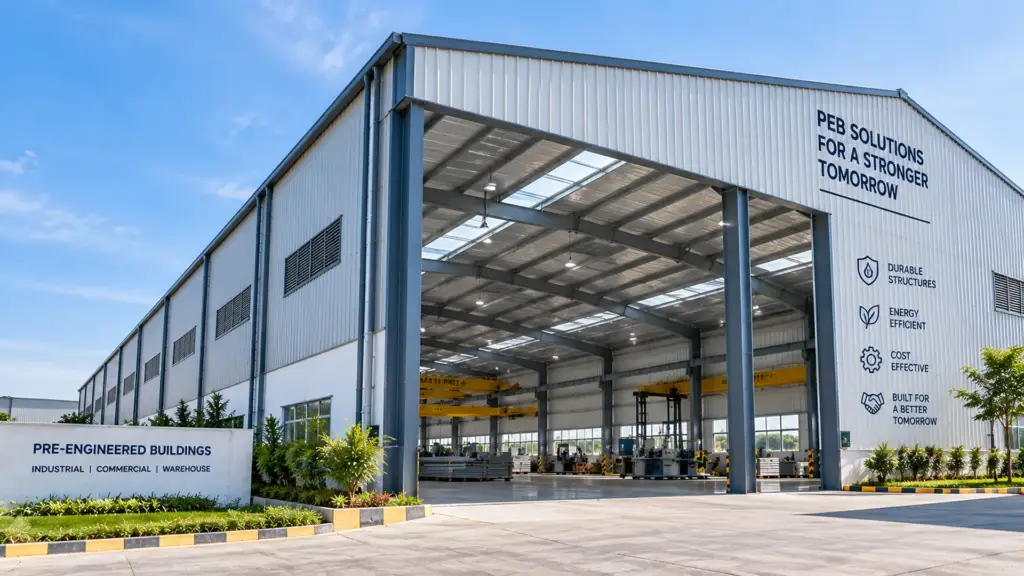
Pre-engineered buildings have some real advantages when it comes to certification, but they’re not automatic — you have to actually use them.
On the plus side, PEBs typically use steel with a meaningful percentage of recycled content, and manufacturers can usually provide documentation on this if asked. The prefabricated nature of the construction also means less on-site waste compared to conventional building methods, since components arrive cut and ready rather than being fabricated on-site with the offcuts that generates. Roofing and insulation systems used in PEBs can be chosen specifically to improve thermal performance, which feeds directly into energy-related credits. And because PEB layouts are flexible, adding skylights or roof monitors for natural daylighting is usually a straightforward design decision rather than a major structural change.
Where PEBs fall short is when none of this is actually specified. A standard, no-frills PEB order — basic roofing sheet, no insulation upgrade, no thought given to daylighting — won’t earn you much on the certification side just because it’s steel. The material being naturally recyclable doesn’t automatically translate into certification points; you have to document it, and you have to build the energy-saving features in rather than assuming they come standard.
What to Specify at the PEB Design Stage for Certification Readiness
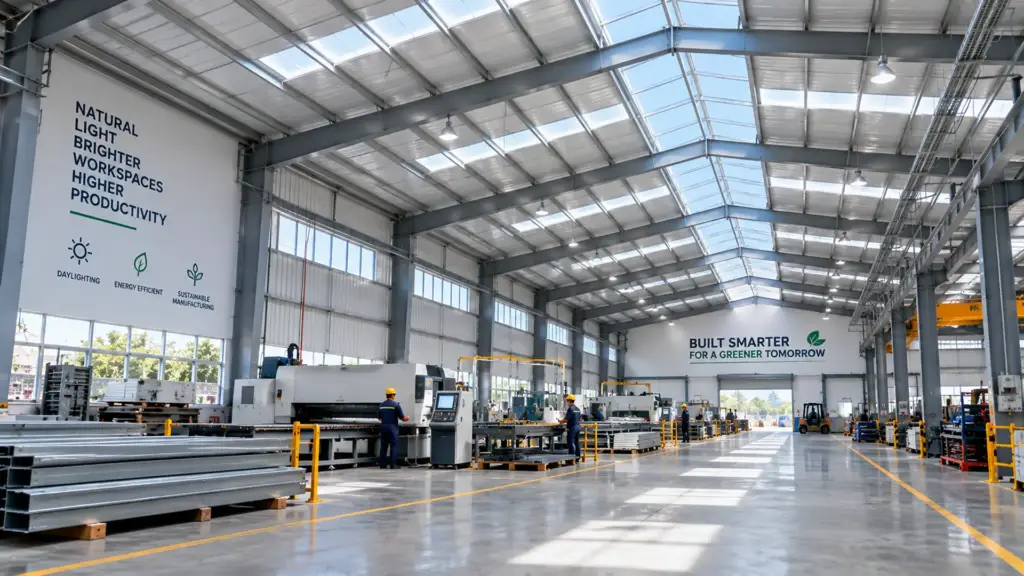
If green building certification (IGBC/LEED) for PEB factories is on your radar, the smartest time to think about it is before you finalize your PEB order — not after construction starts.
Roofing & Insulation Choices
Ask about insulated panel options rather than defaulting to basic sheeting. Better insulation directly affects how much energy your factory uses for cooling or heating, which is one of the more heavily weighted areas in most green rating systems.
Daylighting & Layout Decisions
Skylights, roof monitors, or strategically placed wall openings can cut your daytime lighting load significantly, and they’re far easier to plan into a PEB layout at the design stage than to retrofit later. If certification matters to you, raise this conversation early with your manufacturer.
Documentation to Request From Your Manufacturer
Before you sign off on your PEB order, ask for:
- Recycled steel content certification
- Any available Environmental Product Declarations (EPDs) for the materials being used
- Insulation specifications and performance data for the roofing and wall systems
- Any other material sourcing documentation your certification consultant is likely to ask for
Getting this at the order stage saves you from chasing paperwork months later, once construction is already underway and the documentation trail is harder to reconstruct.
The PEB Manufacturer’s Role vs. the Architect/Consultant’s
One of the most common points of confusion in this whole process is who’s actually responsible for what.
Your PEB manufacturer’s job is to provide the building itself along with the material documentation that supports it — recycled content certificates, insulation specs, EPDs where available, and structural details. This is the paper trail that proves what’s actually gone into your building.
Your architect or certification consultant’s job is different — they handle the IGBC or LEED registration, manage the submission process, run any required energy modeling, and act as your liaison with the certifying body throughout the process.
The problem is that a lot of factory owners assume this is entirely the consultant’s job and don’t realize the manufacturer needs to be looped in from the start. If your PEB supplier isn’t providing documentation as the building is being made, your consultant ends up stuck trying to gather it retroactively — which slows everything down and sometimes means credits get missed simply because the paperwork wasn’t captured in time. Getting both sides talking early makes the whole process considerably smoother.
FAQs
No, it’s not a blanket requirement. It may become relevant depending on your industry, your clients, or specific local policies tied to your project, but it isn’t a default mandate for all factory buildings.
Timelines vary by project, but the process typically runs alongside your construction schedule since documentation needs to be gathered as the building comes together, not after it’s finished.
IGBC does offer rating systems aimed at existing buildings, separate from the ones for new construction, so retroactive certification is possible — though you’ll likely have less flexibility on design-stage choices like insulation and daylighting compared to certifying from the start.
LEED tends to carry more weight with international buyers and overseas parent companies simply because of its global recognition. IGBC is well understood within India but less familiar to buyers abroad.
A certified, energy-efficient building can be more attractive to future buyers or tenants — particularly ones with their own sustainability commitments — though the impact varies by market and isn’t guaranteed to show up as a fixed premium.