If you’re planning to set up a factory in India, chances are you’ve already come across dozens of articles about business loans, MSME schemes, and working capital. But here’s what most of them miss: when it comes to PEB financing or loan options for factory setup in India, a pre-engineered building (PEB) project doesn’t behave quite like a traditional RCC one.
The way PEB projects get built — faster, with fewer moving parts on site — actually changes how you should think about loan sizing, disbursement, and even the paperwork you submit to your lender.
This guide walks you through the loan types available for a PEB factory setup in India, how to compare lenders, what Gujarat-based manufacturers specifically need to know, how to put together a project report that actually gets approved, and a real-numbers example so you’re not left guessing.
PEB vs. RCC — How Construction Method Changes Your Loan Structure
Most financing articles treat “factory construction” as one generic category. But a PEB project behaves differently from a conventional RCC build in ways that directly affect your loan.
PEB structures are typically fabricated off-site and assembled on location, which is why they’re known for cutting construction timelines significantly compared to RCC — often by a considerable margin. That speed matters more than people realize when it comes to exploring PEB financing or loan options for factory setup in India.
Here’s why: banks usually disburse construction loans in tranches, tied to project milestones. With RCC, those milestones are spread over a longer construction period, which means you’re paying pre-EMI interest (interest on the amount already disbursed) for a longer stretch before the factory is even operational. With PEB, because the structure goes up faster, the disbursement cycle compresses — fewer tranches, spread over a shorter window. In practice, this can mean less time paying interest on funds before your factory starts generating revenue.
On top of that, PEB construction generally costs less per square foot than RCC, largely because of optimised steel usage and reduced labour and time on site. A lower project cost means you may need to borrow less overall, which directly improves your debt servicing ratio — one of the key numbers a lender looks at before sanctioning a loan.
Why Lenders View PEB Projects Favourably
From a lender’s perspective, a shorter construction timeline means a shorter “project implementation risk” window — the period during which things can go wrong before the asset starts earning. Factory-fabricated components also reduce the risk of cost overruns from on-site delays, weather disruption, or labour shortages, which are common concerns with traditional construction. This doesn’t guarantee easier approval, but it’s a genuine point in your favour when you’re presenting your case to a bank or NBFC.
Types of Loans Available for PEB Factory Setup
Once you’ve decided to build with PEB, you’ll likely need more than one type of loan to cover the full project — construction, machinery, and day-to-day operations often come from different sources. Knowing which loan fits which need is a big part of getting PEB financing or loan options for factory setup in India right from the start.
Term Loans
This is the main instrument for funding your land, the PEB structure itself, and any machinery you’re installing. Term loans are repaid over a fixed tenure through EMIs, and the repayment period is usually matched to the useful life of the asset being financed.
Working Capital Loans
Once your factory is up and running, you’ll need funds for raw materials, wages, and other day-to-day operational costs. This is a separate loan from your construction financing — don’t expect your term loan to cover ongoing operations.
Equipment & Machinery Finance
If you’re installing production machinery inside your PEB shed, this is often financed separately from the structure itself, sometimes through equipment-specific loan products with repayment terms tied to the machinery’s expected lifespan.
MSME & Government-Backed Loans (CGTMSE, PMEGP, Mudra)
If you qualify as an MSME, schemes like CGTMSE (Credit Guarantee Fund Trust for Micro and Small Enterprises) can help you access collateral-free loans, since the government guarantee reduces the risk for the lender. PMEGP and Mudra loans are generally aimed at smaller units and first-time entrepreneurs, with lower ticket sizes than a typical industrial term loan.
Project Finance (Large-Scale Units)
For bigger PEB factory projects, you may be looking at project finance — often structured through a single large lender or a consortium of banks — designed for substantial capital investment that goes beyond what a standard term loan covers.
Lender Comparison — Interest Rates, Tenure & Collateral at a Glance
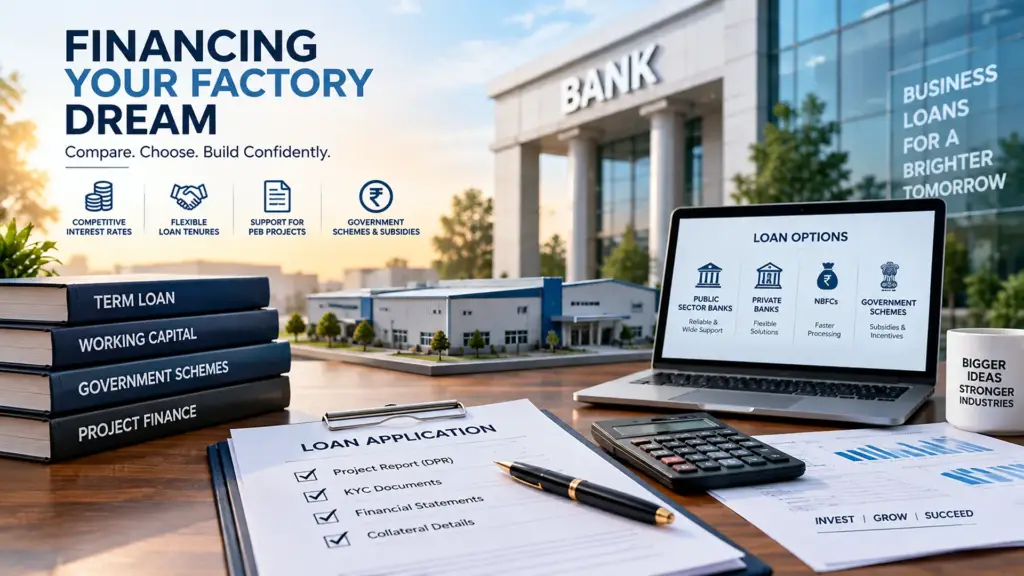
Interest rates and terms vary by lender, your credit profile, and the size of your project, so treat the table below as a general reference point rather than a quote. Always confirm current rates directly with the bank or NBFC before making a decision.
| Loan Type | Typical Lenders | Collateral Requirement | Tenure |
|---|---|---|---|
| Term Loan (construction/PEB structure) | PSU banks, private banks, NBFCs | Usually secured against the asset/property | Medium to long-term, matched to asset life |
| Working Capital Loan | PSU banks, private banks, NBFCs | Can be secured or unsecured depending on profile | Short-term, renewable annually |
| Equipment/Machinery Finance | NBFCs, banks with equipment finance desks | Often secured against the machinery itself | Matched to machinery lifespan |
| CGTMSE-backed MSME Loan | PSU banks, private banks, SIDBI | Collateral-free (government guarantee) | Varies by scheme |
| Project Finance | Large PSU/private banks, consortiums | Secured against project assets | Long-term |
If you’re comparing offers, don’t just look at the headline interest rate — ask about processing fees, prepayment charges, and how the disbursement schedule is structured. For a PEB project, it’s worth specifically asking whether the lender can adjust the tranche schedule to match your shorter construction timeline, since not all standard templates account for this.
Gujarat-Specific Financing & Subsidy Stack
If you’re setting up your PEB factory in Gujarat, there’s an additional layer worth exploring beyond central government schemes. Gujarat’s state industrial policy has historically offered incentives for new manufacturing units, which can include capital subsidies and interest support, depending on the scheme active at the time and your unit’s category (micro, small, medium, or large).
Gujarat has also offered SGST reimbursement mechanisms for eligible new industrial units under various policy cycles, which can meaningfully reduce your effective tax outgo in the early years of operation.
The important thing to understand is sequencing: state-level incentives are usually layered on top of central schemes like CGTMSE or PMEGP, not instead of them. Eligibility criteria and application windows change with each policy cycle, so before you finalise your financing plan, check directly with the Gujarat Industries Commissionerate or your district industries office for the current scheme details and application process — this is an area where relying on older blog posts can cost you an incentive you were actually eligible for.
How to Prepare a Bankable DPR for a PEB Factory
A Detailed Project Report (DPR) is what most lenders and government schemes require before they’ll even consider your loan application. The problem is, most DPR guidance available online is written generically for “factory loans,” without accounting for what makes a PEB project different — and getting this part right matters just as much as picking the right loan when you’re weighing PEB financing or loan options for factory setup in India.
For a PEB factory, your DPR should clearly separate and detail:
- Steel tonnage and structure specifications — lenders want to see the scale of the PEB structure, not just a lump-sum construction cost
- Fabrication and erection timeline — since this is where PEB’s speed advantage shows up, spell it out clearly rather than using a generic construction schedule
- Foundation cost, shown separately from superstructure cost — this is often bundled together in generic templates, but lenders assessing a PEB project benefit from seeing it broken out
- Manufacturer/vendor credentials — including their track record and any relevant certifications, since this reassures the lender about execution risk
Because PEB construction is faster, your disbursement-milestone schedule in the DPR should reflect that — don’t submit a generic RCC-style milestone timeline stretched over many months when your actual build will be completed much sooner. A DPR that mirrors your real timeline tends to move through approval faster, since it gives the lender a clearer, more credible picture of the project.
Many manufacturers choose to get professional help preparing the DPR, since a well-structured report with realistic projections and a proper break-even analysis genuinely improves your chances of faster sanction — even though it adds some upfront cost.
Worked Example — Financing a 20,000 Sq Ft PEB Factory
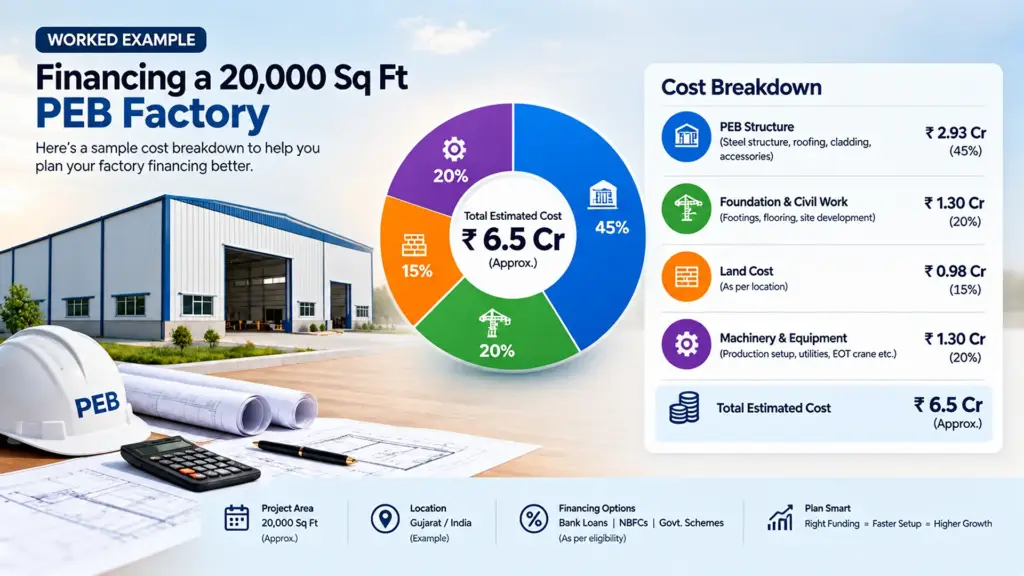
To make this more concrete, here’s an illustrative example of how the numbers might come together for a 20,000 sq ft PEB factory. These figures are indicative only, meant to show how the pieces fit — not a quote. Actual costs depend heavily on location, specifications, and current material prices, so always get a project-specific estimate from your PEB manufacturer before finalising your loan application.
A typical cost breakdown might include:
- Land (if not already owned)
- PEB structure (steel, fabrication, erection)
- Foundation and civil work
- Utilities and site development
- Machinery and equipment
Once you have a realistic total project cost, most lenders will finance a portion of it through a term loan, with the balance coming from promoter contribution (your own funds) and, where applicable, subsidy support that reduces your net borrowing requirement.
From there, your EMI depends on the loan amount, interest rate, and tenure you’re offered — a longer tenure lowers your monthly outgo but increases total interest paid over the life of the loan, so it’s worth running a few different scenarios before committing.
Because PEB construction gets you to operational status faster than RCC, your break-even timeline can also start earlier — production and revenue generation begin sooner, which matters when you’re planning cash flow against your EMI schedule. This is really the core financial argument for PEB: it’s not just a construction choice, it’s a financing advantage too.
Eligibility & Documentation Checklist
Before you approach a lender, here’s what you’ll typically need ready:
- Detailed Project Report (DPR)
- Land ownership or lease documents
- Cost quotations from your PEB manufacturer
- GST returns and business financial statements
- KYC documents (identity and address proof)
- Udyam registration (for MSME eligibility and scheme benefits)
- Bank statements for the past 6–12 months
Having these organised upfront speeds up the entire process — incomplete documentation is one of the most common reasons loan approvals get delayed.
FAQs
Rates vary by lender, loan type, and your credit profile, so there’s no single fixed number. It’s best to get quotes from a few banks and NBFCs and compare them directly, including processing fees and prepayment terms.
If you qualify as an MSME, schemes like CGTMSE can offer collateral-free financing, since the government guarantee reduces the lender’s risk. Eligibility depends on your business category and loan amount.
Timelines vary by lender and how complete your documentation is. A well-prepared DPR with realistic projections tends to move through approval noticeably faster than an incomplete or generic application.
Gujarat’s state industrial policy has historically included incentives for new manufacturing units, potentially alongside SGST reimbursement. Since scheme details change with each policy cycle, check current eligibility with the Gujarat Industries Commissionerate before finalising your plans.
Ready to Plan Your PEB Factory?
Getting your financing right starts with getting your project numbers right. As a PEB manufacturer, we can help you put together accurate cost estimates and realistic construction timelines — the kind of detail that strengthens your DPR and gives your lender confidence as you weigh PEB financing or loan options for factory setup in India. Reach out to us for a quote tailored to your factory’s requirements.