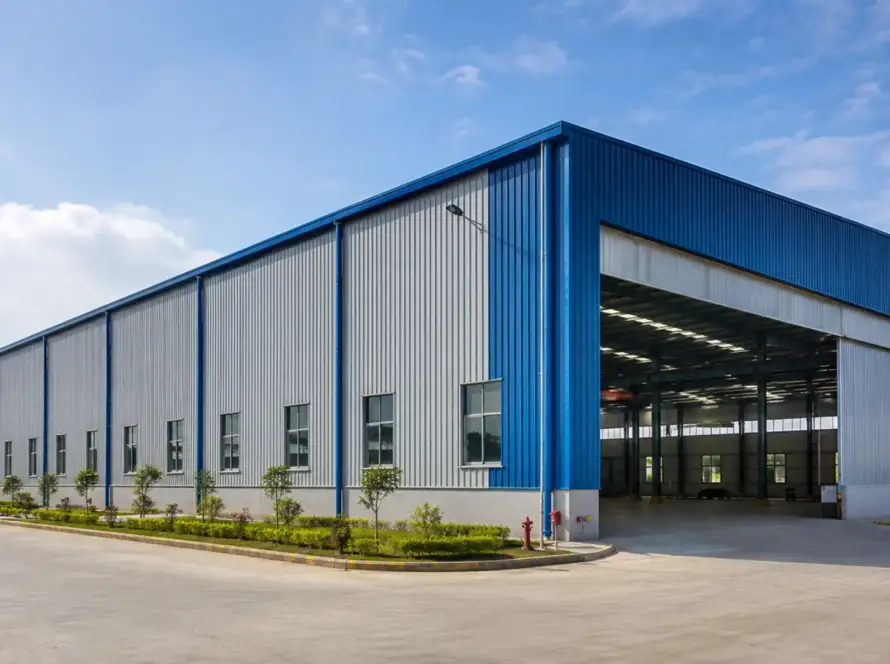
Cold chain demand across Gujarat is growing faster than most owners’ understanding of what actually makes a cold storage building work. Pharma companies need warehousing that meets strict temperature and compliance rules. Dairy and frozen food processors are adding capacity every year. Agri-exporters need buildings that can hold produce cold long enough to survive the trip to a foreign port without spoiling. If you’re searching for a Pre-Engineered Buildings (PEB) Manufacturer in Vadodara, this is exactly the kind of capacity most of them are building right now, and there’s a good reason for that.
Here’s the problem, though. Most operators don’t find out their building has a design flaw until it’s already costing them money. Nobody notices bad thermal design on the day the building opens. What they notice, a year or two later, is the power bill creeping up, condensation showing up on walls, and product loss nobody can quite trace back to a cause — until someone finally cuts open a wall panel and finds the real story.
This piece isn’t going to tell you PEB is faster and cheaper and leave it at that. It is faster and usually cheaper. But that’s not the whole picture. What actually decides whether a cold storage building performs for twenty years or falls apart in five is what’s happening inside the wall assembly, what the costs actually break down to, and what compliance really demands. That’s what this covers, and why choosing the right PEB partner matters as much as the material specs themselves.
Choosing a Pre-Engineered Buildings (PEB) Manufacturer in Vadodara: What Is a PEB?
A pre-engineered building is a steel structure fabricated in a factory to exact specifications, then trucked to site and bolted together — instead of being built piece by piece on location, the way conventional RCC (reinforced cement concrete) construction works.
That one shift, from site-built to factory-built, changes a lot downstream. Tolerances are tighter. Joints come out consistent because a machine cut them, not a crew improvising with what they had on hand that day. For a normal warehouse, this is a nice bonus. For cold storage, it’s the difference between a building that holds its performance for decades and one that starts breaking down within a few seasons — because in this application, a gap the width of a fingernail in the insulation layer is enough to start a condensation problem. This is precisely the kind of precision a reliable Pre-Engineered Buildings (PEB) Manufacturer in Vadodara should be building around from day one.
The Real Engineering Behind Cold Storage PEBs
Most articles on this topic stop at “it’s insulated and energy-efficient” and move on. That’s not enough to actually understand what you’re buying. The real performance of a cold storage building comes down to a small number of engineering details, and they either get handled correctly or they don’t.
Thermal Bridging — What It Is and How Good PEB Design Actually Stops It
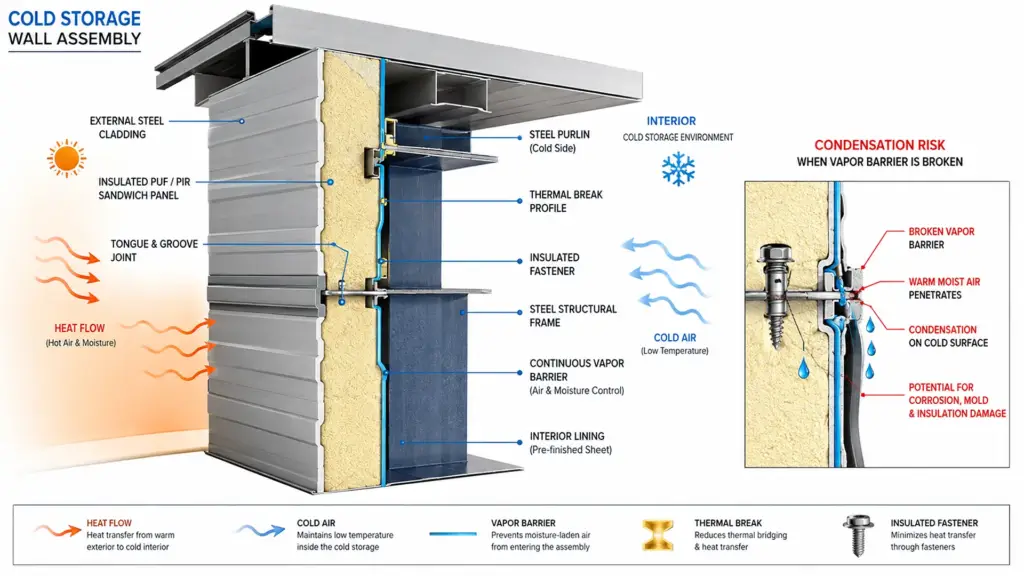
Thermal bridging is what happens when heat finds a shortcut through something that conducts it faster than the insulation around it — usually a steel connection, a fastener, or wherever structure punches through the building envelope. Steel is excellent for holding a building up and terrible at stopping heat. Anywhere steel runs continuously from outside to inside, you’ve got a bridge for heat to cross, and the insulation around it doesn’t matter much once that’s happening.
In a badly designed cold storage building, this shows up as cold spots on interior surfaces — and that’s exactly where condensation starts. Well-built PEB cold storage design tackles this with interlocking tongue-and-groove panel joints instead of basic lap joints, which closes off the gaps where air (and heat) would otherwise sneak through. Thermal break profiles sit at every point where steel structure meets insulated panel, physically interrupting that conductive path. And insulated fastener systems replace standard steel purlins, because exposed purlins behind the panel are, in my experience, one of the most common thermal bridging problems in cold storage — and one of the easiest to miss during design review.
Vapor Barrier Continuity — Why One Broken Seal Ruins Everything
Everyone talks about panel R-value. Vapor barrier continuity matters just as much, arguably more, for how the building actually performs over time. A small break in the vapor seal lets moist air migrate into the wall assembly. In a cold environment, that moisture condenses. Condensation inside a panel doesn’t just sit quietly — it feeds mold, and over time it can freeze inside the panel core. Ice expansion breaks down the panel from the inside, and once moisture reaches the steel frame behind it, corrosion sets in, and that’s expensive to fix once it’s started.
This is why joint sealing deserves as much attention as the insulation spec sheet. A panel with a strong R-value and sloppy joint sealing will underperform a slightly weaker panel that’s sealed properly. And this is the failure mode most owners never see coming, because on paper the building looks fine. The seal problem usually doesn’t show itself until three to five years in, by which point the fix means cutting into walls that were supposed to last the life of the building.
Insulation Panel Types & R-Value Reality Check
Panel core material changes the thickness you need, the fire rating you get, and what it costs.
| Panel Type | Relative R-Value | Fire Performance | Typical Cost |
|---|---|---|---|
| PUF (Polyurethane Foam) | High | Moderate — needs proper facing/treatment | Moderate |
| PIR (Polyisocyanurate) | High, better fire resistance than PUF | Better than standard PUF | Moderate-High |
| EPS (Expanded Polystyrene) | Lower than PUF/PIR at the same thickness | Lower — usually needs added fire protection | Lower |
| Rockwool (Mineral Wool) | Moderate | Excellent — inherently fire-resistant | Higher |
(Suggested visual: labeled panel cross-section diagram showing core, facing, and joint detail.)
The right pick depends on what’s going inside the building and which fire code applies. Pharma cold storage tends to lean toward the higher fire-rated panels even at a cost premium, because insurance and regulatory requirements for pharma are stricter than for general food storage — and cutting corners here is the kind of decision that looks smart on a budget sheet and terrible three years later.
PEB vs. RCC: The Real Cost Breakdown
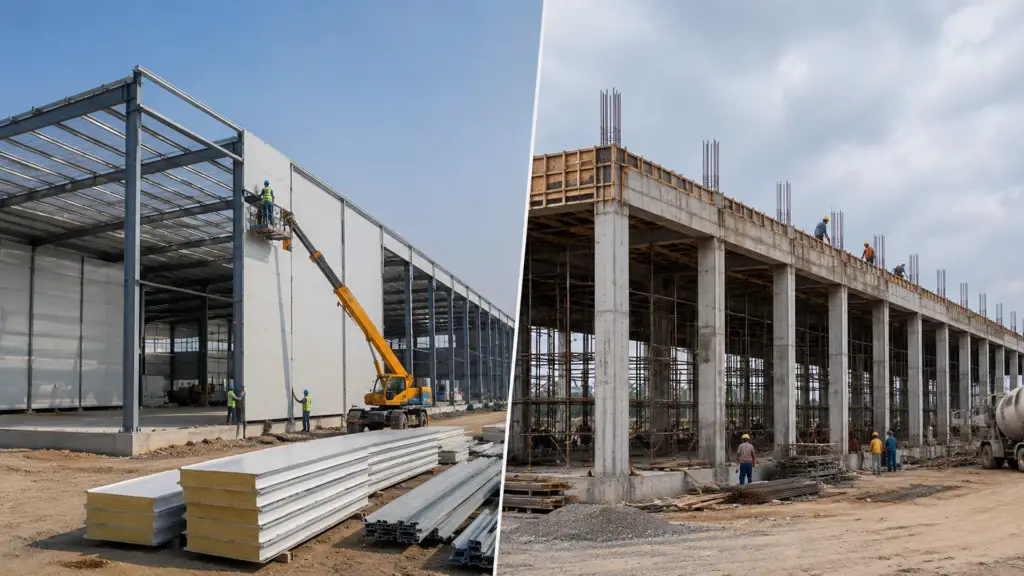
Most articles quote a savings percentage and move on without showing where the number came from. Here’s the actual breakdown.
Cost Comparison Table
| Cost Component | PEB | RCC |
|---|---|---|
| Structure/framing | Factory-fabricated, faster to erect | Site-built, more labor-intensive |
| Insulated panel envelope | Integrated into the design from the start | Often bolted on later as a retrofit layer |
| Refrigeration integration | Planned in early alongside the structure | Frequently an afterthought, adds rework |
| Foundation/land prep | Lighter foundation loads in most cases | Heavier foundation requirements |
| Construction timeline | Shorter, thanks to prefabrication | Longer, because work happens in sequence |
| Cost per sq ft | Generally lower | Generally higher |
Where the Savings Actually Come From
The savings aren’t magic. Faster erection means fewer weeks paying labor and site overhead, and on a large facility that adds up quickly. Factory precision also means less wasted material and far less on-site rework, since panels and structural members show up already cut and fitted instead of being adjusted by hand on location.
It’s also worth being straight about where PEB doesn’t save you anything. Refrigeration equipment — compressors, evaporators, controls — costs roughly the same no matter what the shell is built from. That cost is driven by the refrigeration load and system design, not the structure around it. Anyone budgeting a cold storage project should treat structure cost and refrigeration cost as two separate conversations. Bundling them into one number is how budgets go wrong.
5 Ways Cold Storage Buildings Fail — And How PEB Design Prevents Them
- Condensation from broken vapor seals — moisture gets in through gaps and damages panels over time. PEB uses continuous, factory-sealed panel joints to keep the vapor barrier intact.
- Thermal bridging at structural penetrations — heat sneaks through steel connections and fasteners. Thermal break profiles and insulated fastener systems interrupt that path.
- Panel joint failure under thermal cycling stress — repeated expansion and contraction loosens standard joints over time. Interlocking tongue-and-groove joints hold up better under that stress.
- Foundation settling under sustained refrigeration load — constant cold plus equipment weight stresses a poorly designed foundation. PEB’s lighter structural loads reduce that strain compared to RCC.
- Refrigeration load mismatch with building envelope performance — refrigeration that’s sized wrong for how the envelope actually performs wastes energy. Designing structure and refrigeration together, rather than as separate decisions, is what prevents this.
Compliance & Standards: What a Cold Storage PEB Actually Needs to Meet
Compliance isn’t a box to tick before opening day. It’s a set of technical benchmarks the insulation, structure, and fire safety systems have to actually meet, not just claim to meet on a spec sheet.
Insulation performance gets measured by U-value — how much heat passes through the envelope — and a lower U-value means better performance. Fire codes matter a lot for insulated panel buildings specifically, since some core materials (EPS, for instance) are more combustible than others (Rockwool), so the fire rating you need depends on what’s stored and the local fire code. Structural and seismic considerations come into play too, depending on region, since a cold storage building carries load patterns a standard warehouse doesn’t.
In India, cold storage built for food handling generally needs to line up with FSSAI’s cold chain guidelines, along with the relevant IS codes covering structure and insulation. For anyone exporting or dealing with stricter international markets, ASHRAE’s refrigeration and insulation guidance is a reference point worth knowing even outside the US, simply because it’s one of the more thorough technical standards available for this kind of design.
Compliance is what determines whether a facility gets insured properly, whether it can be certified for pharma or food-grade storage, and what it’s actually worth if the owner ever wants to sell or lease it. Skip it and you’re not just risking a fine — you’re risking the resale value of the asset.
Life Beyond Construction — What 10-15 Years of Ownership Actually Looks Like
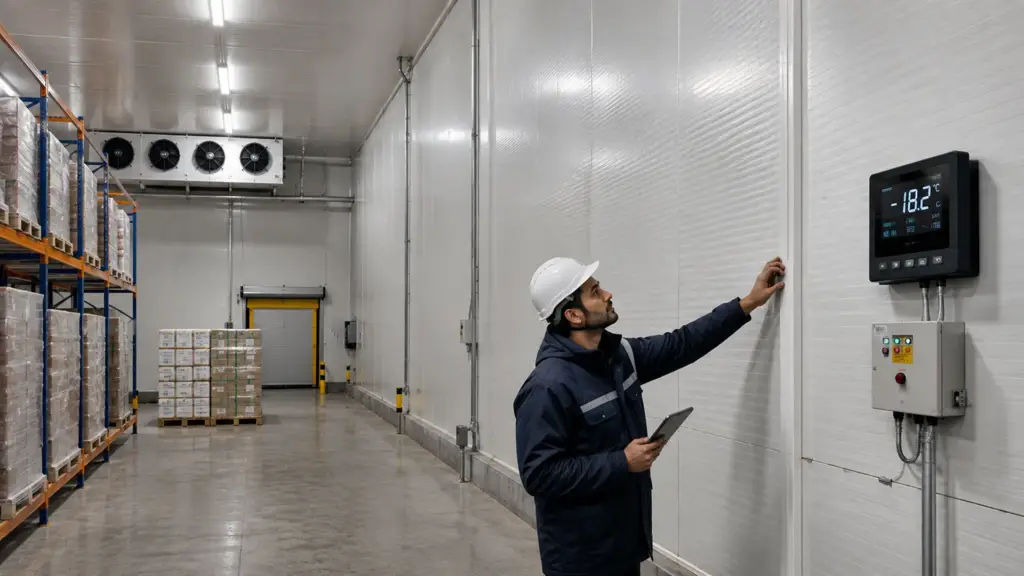
A cold storage building doesn’t stop needing attention once construction wraps. Insulation panels degrade slowly — moisture, UV exposure on the exterior facing, general wear — and most facilities end up needing to think about re-insulation or panel replacement somewhere in that 10-15 year window, depending on how well the envelope was built in the first place.
Energy monitoring matters more than most owners expect going in. Envelope performance drifts. A joint sealed perfectly on installation day can loosen slightly after years of thermal cycling, and the first sign is usually a slow rise in energy cost, not anything visible. Catching that early is a lot cheaper than catching it late.
A basic maintenance routine covers most of it: regular seal inspections, checking panel joints for gaps or damage, and periodic refrigeration efficiency audits to confirm the equipment still matches the building’s actual thermal performance. For procurement and finance teams weighing a cold storage investment, this is exactly why total cost of ownership deserves more weight than the upfront construction number. A cheaper build that costs more to run for ten years isn’t actually the cheaper option — it just moves the cost to a different line item.
Choosing a Pre-Engineered Buildings (PEB) Manufacturer in Vadodara
A pre-engineered building for cold storage isn’t just the faster, cheaper way to build — though it usually is both. It comes down to the engineering inside the wall assembly, knowing where the real costs sit, meeting the compliance standards that protect insurance and resale value, and thinking about the building’s performance over its full life, not just the day it opens.
That’s also why the manufacturer you choose matters more than the price quote alone. A trusted Pre-Engineered Buildings (PEB) Manufacturer in Vadodara should be able to walk you through the thermal design, the panel specs, and the compliance requirements before a single sheet of steel gets cut. If you’re evaluating a cold storage project in the region, start with a feasibility consultation or a detailed cost estimate rather than a generic quote. That’s the only way to know whether a proposed design actually holds up to what your facility needs to meet.