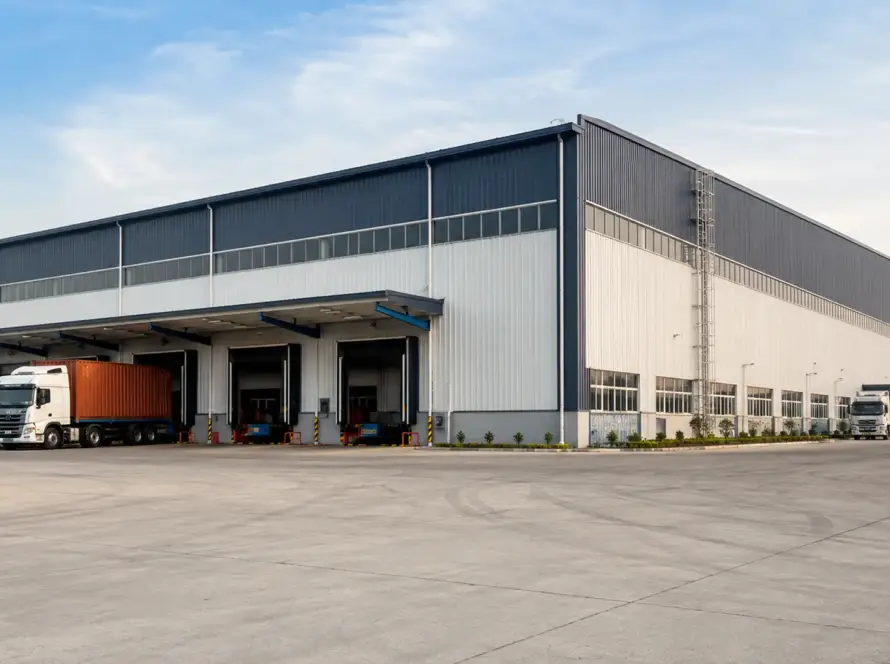
Construction costs keep going up. Skilled labor is a pain to find most years. And lately, tariff-driven material delays have been known to stall a project for months before anyone’s even poured a foundation. If you own a factory, you already know this pressure. It’s a big part of why so many owners are now looking at Pre-Engineered Buildings (PEB) instead of just doing what they’ve always done.
I won’t pretend PEB is right for everyone. There are situations where it’s genuinely the wrong call, and I’ll walk through those too — pretending otherwise doesn’t actually help anyone trying to make a real decision. So below you’ll find realistic cost and timeline numbers, a checklist for vetting vendors before you sign anything, and a fairly blunt look at what ownership costs you over 15 to 20 years, not just the number sitting on the handover invoice.
What Is a Pre-Engineered Building (PEB)?
A Pre-Engineered Building, or PEB, is basically what it sounds like. The primary and secondary steel members, the roofing, the cladding — all of that gets designed and fabricated off-site to exact load specs, then trucked in and bolted together once it lands on your plot. Compare that to conventional RCC construction, or even site-fabricated steel, where a lot of the design and welding calls get made on the fly, while the crew is standing right there. With PEB, most of that decision-making already happened before anyone shows up on site. That’s really the whole trick behind it.
If you already know all this, skip ahead.
When PEB Is Not the Right Choice
PEB doesn’t work for every project, and it’s worth being upfront about where it breaks down.
- Poor soil conditions. If your site needs heavy custom foundation work to compensate for weak or unstable soil, you’ll lose most of the speed and cost advantage right there. The foundation becomes the bottleneck, not the steel.
- Highly irregular layouts. Buildings with odd curves or non-standard shapes usually need the flexibility that only site fabrication gives you. PEB systems are built around repeatable, straightforward forms — not one-off architectural statements.
- Small or one-off structures. Most of the value in PEB comes from factory tooling and standardized processes. For something very small, or truly one-time, the setup cost may not be worth it against just building conventionally.
- Limited site access. Tight crane access or narrow transport roads can turn hauling in large prefabricated panels into a real logistical headache — one that eats into the time savings you were counting on.
If none of that sounds like your project, Pre-Engineered Buildings (PEB) are genuinely worth a serious look.
Where PEB Wins — Speed, Strength & Cost Savings
Speed: Faster From Design to Occupancy
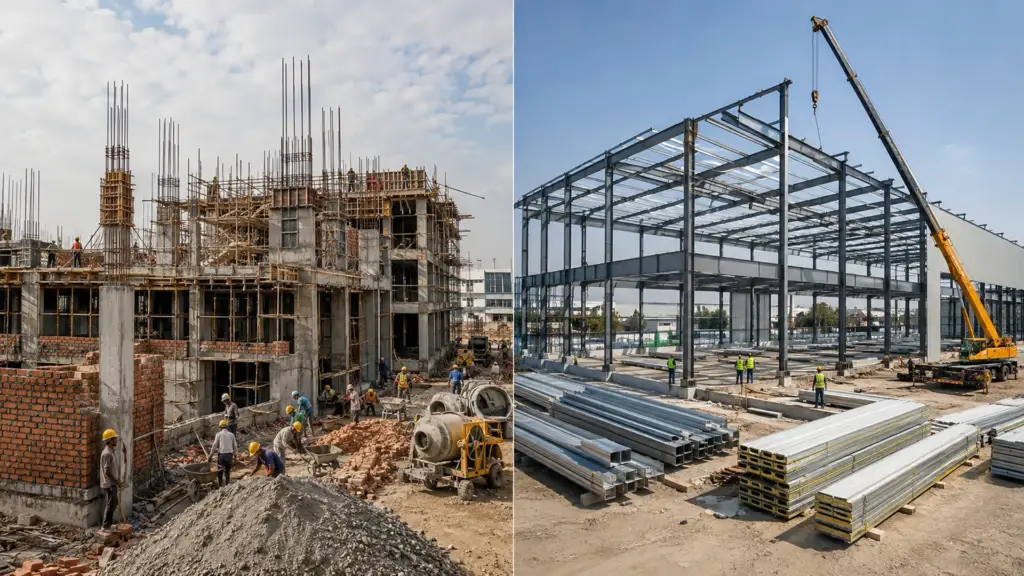
Steel gets fabricated off-site while foundation and prep work happen at the same time on the ground. That overlap is pretty much the whole reason PEB projects tend to run 30 to 50% faster than conventional builds, give or take, depending on size and complexity. It’s a range, not a promise — actual timelines still come down to approvals, site conditions, and logistics on the day. But the pattern shows up again and again: less weather exposure, and a lot less scrambling to find skilled labor on site, which are two of the more common reasons conventional builds run late.
Strength & Engineering Precision
PEB structures get engineered around the loads they’ll actually face — wind, seismic activity, snow, whatever applies to that region — calculated for that specific project rather than lifted from some generic template. Because the steel comes out of a controlled factory setting, quality control ends up a lot more consistent than site welding, where results can swing depending on which crew turns up that week. Most PEB systems also use corrosion-resistant cladding, which helps the structure last through its intended lifespan and keeps long-term upkeep from getting out of hand.
Cost Savings: What’s Actually Driving the Number
The savings aren’t coming from one clever trick. They add up from a handful of places:
- Steel sections get sized for actual load requirements, so you’re not paying for tonnage you don’t need
- Site labor drops, since most of the work is bolting together pre-fabricated pieces rather than building from raw materials
- Weather delays shrink because less of the critical work happens exposed outdoors
- The bill of quantities gets locked in early, so mid-project surprises are rarer
Add it up and you’re usually looking at 10 to 20% savings compared to conventional construction. Exactly where you land depends on scale, location, and material prices at the time you build — so if a vendor throws out a fixed percentage without knowing your site, take that number with a pinch of salt.
Real Project Snapshot: Timeline, Tonnage & Cost Breakdown
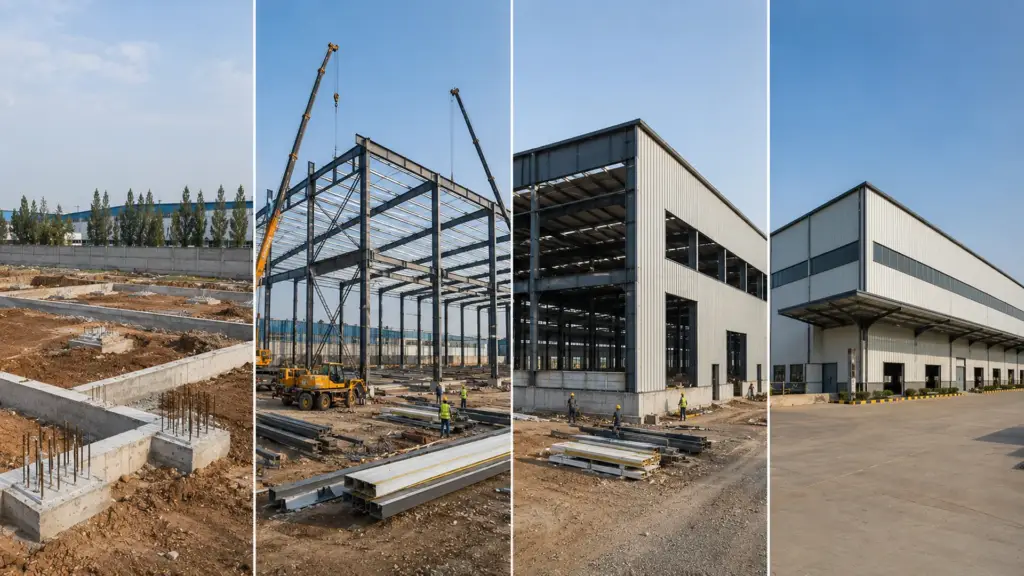
Here’s a grounded example, based on a fairly typical mid-sized PEB factory build. These numbers reflect a common project profile — not one specific client, just a realistic composite.
Say you’re building a 30,000 sq. ft. single-storey industrial shed with a 6-meter eave height. Steel requirement usually works out to around 4 to 4.5 kg per sq. ft., putting you somewhere around 120 to 135 tonnes of primary and secondary steel combined.
Foundation and civil work generally takes 3 to 4 weeks on a job this size — the RCC footings still need proper casting and curing, so nothing speeds that part up just because the superstructure is steel. Once the foundation’s set, factory-fabricated columns, rafters, and purlins usually start turning up on site within 5 to 6 weeks of order confirmation. That overlap, foundation work happening while fabrication runs in parallel elsewhere, is really where all the time gets saved. Erection of the frame, roofing, and cladding then wraps up in another 3 to 4 weeks.
Foundation to handover, all in, often lands somewhere between 10 and 14 weeks. For comparison, an equivalent RCC-frame shed built the conventional way usually takes 7 to 9 months.
On cost, PEB sheds in this size and spec range typically run ₹900 to ₹1,300 per sq. ft. all-in — structure, roofing, and basic cladding included. A conventional RCC shed of the same footprint often runs 15 to 25% higher once you count formwork, longer labor deployment, and extended site supervision. But honestly, the real difference isn’t even the per-square-foot figure. It’s the time. Getting into production a few months sooner is usually worth more than whatever you saved on the build itself.
The True Cost of Ownership: Beyond Construction
Construction cost is only half the story here. What happens after handover matters just as much, and it’s the part most comparisons quietly skip past.
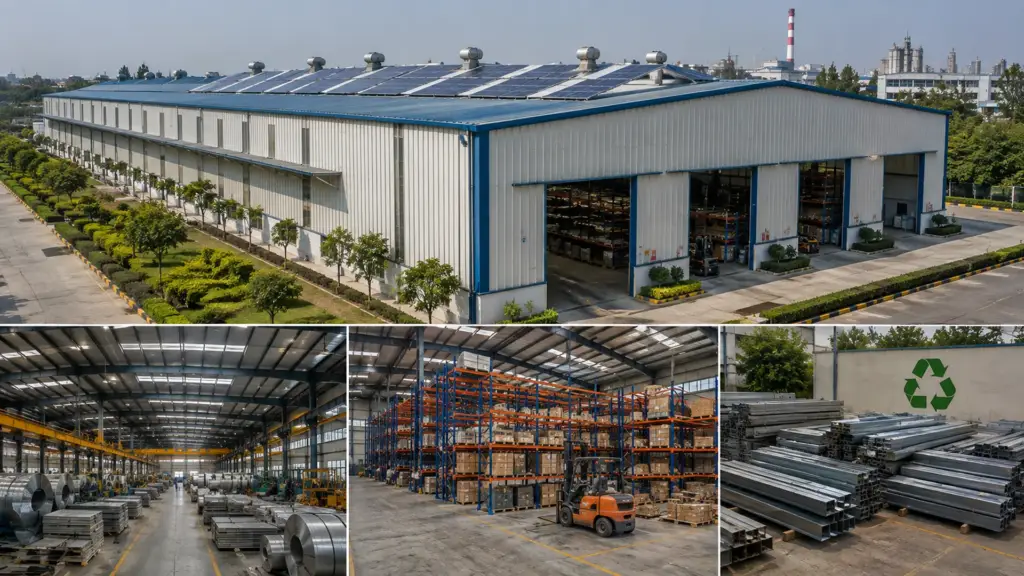
On energy performance, PEB roofs can be specified with PUF or rockwool insulated panels, and that makes a real dent in heat gain across large floor areas — worth knowing if you’re running machinery that doesn’t do well in high ambient temperatures. Steel roof profiles are also easier to make solar-ready from the start, since the spacing and load calculations can account for panel mounting during design instead of getting bolted on as an afterthought.
On maintenance, steel needs periodic anti-corrosive repainting, usually every 5 to 7 years depending on the coating and the local environment, and roof sheeting tends to last 15 to 20 years before it needs swapping out. RCC isn’t maintenance-free either — you’re still dealing with waterproofing, crack repair, plaster upkeep, the whole list. So it’s not really zero maintenance versus some maintenance. It’s more a question of which set of tasks is easier to predict and budget for, and steel tends to win that one because the schedule is more foreseeable and less disruptive to whatever’s running inside.
At end-of-life, steel has a clear edge. Structural steel keeps scrap value and can often be dismantled and partly reused or sold off. Demolishing an RCC structure mostly just produces debris headed for landfill, with barely anything recoverable.
Supply Chain & Tariff Risk: Why Timing Matters Right Now
Material price volatility isn’t some abstract risk anymore — it’s already showing up in project timelines. A recent AIA survey of architecture firms found that nearly 40% of contracted projects had officially gone on hold or were quietly paused, and firms pointed straight at tariff-driven uncertainty around material costs as part of the cause.
Pre-Engineered Buildings (PEB) construction tends to be a bit more insulated from that, mostly because standardized components and factory-controlled fabrication cut down how many things are exposed to sudden price swings. Vendors who manufacture in-house and pre-order steel coil in bulk can often lock in pricing earlier than a contractor sourcing rebar and cement piecemeal as the job goes along.
If you’re talking to suppliers right now, just ask them straight: where’s the steel actually coming from, will they offer any kind of price-lock or lead-time guarantee once you sign, and how exposed is their supply chain to import-dependent components. In a market this shaky, a vendor being upfront about sourcing matters just as much as the number on their quote.
How to Choose a PEB Vendor: A Buyer’s Due Diligence Checklist
Questions to Ask Before You Sign
Get straight answers on these before signing with any PEB fabricator:
- What steel grade are they using, and can they actually produce mill test certificates?
- What load calculation methodology and design software did they use — STAAD.Pro, Tekla, something else?
- Is fabrication done in-house, or outsourced to someone else entirely?
- What does the warranty actually cover — structure, roof sheeting, paint coating — and for how long?
If a vendor gets vague or slippery on even one of these, take it seriously. I’d personally walk away rather than let it slide.
How to Compare Quotes: Per Kg vs. Per Sq Ft
One mistake buyers make all the time is comparing quotes priced in totally different units. Some vendors quote per kg of steel, others per sq. ft. of built-up area, and you can’t really line those up side by side without normalizing them first. A vendor with a lower per-kg rate can still cost you more overall if their design just uses more steel than it needs to. Ask for total tonnage alongside the price, then work out the real per-sq-ft figure yourself — total cost divided by built-up area. That’s the only honest way to compare vendors against each other.
Red Flags That Signal a Bad Fabricator
Keep an eye out for:
- Vague or lump-sum BOQs that don’t break down steel sections, cladding, or accessories
- No independent or third-party load certification available
- Timelines that sound too fast for the tonnage involved
- No site-specific wind or seismic load calculations — a generic design isn’t a safe one
PEB in India: Approvals, GST & Financing Notes
Industrial approval timelines for prefab structures vary a fair bit by state. Some states run fast-tracked single-window clearances for industrial sheds; others still want multiple separate NOCs, which can tack extra weeks onto your planning. It’s worth checking your specific state’s industrial policy directly rather than assuming whatever worked for a plant somewhere else will apply to yours too.
On GST, treatment for Pre-Engineered Buildings (PEB) versus RCC construction can differ depending on whether the structure gets classified as plant and machinery or a conventional building — and that classification affects input tax credit eligibility. It’s a real cost factor, and frankly the kind of thing worth confirming with a tax consultant instead of guessing.
Financing terms can differ too. Some lenders see PEB structures as faster to finish and therefore lower-risk for construction-linked disbursement schedules, while others have their own documentation requirements specific to prefab builds. These rules shift often enough by state and lender that it’s worth checking current requirements with a local consultant or chartered accountant before committing to anything.
Is PEB Right for Your Factory?
Pre-Engineered Buildings (PEB) aren’t automatically the right pick — not for every project. But for most standard industrial footprints, they win pretty decisively on build speed, cost predictability, and long-term value, as long as you’re dealing with a vendor who can actually back up their promises with real certifications and a transparent BOQ, not just a fast quote.
The time you save on construction alone is often reason enough. The maintenance and end-of-life advantages just build on top of that. If you’re weighing PEB against a conventional build for your next facility, get a detailed quote and put it next to what you’d actually pay for RCC. Once the numbers are sitting side by side, the decision usually makes itself.