


If you’re putting up a pre-engineered building anywhere near Gujarat’s coastline or its industrial belt, corrosion isn’t a “maybe” problem. It’s a “when” problem. Choosing the right anti-corrosion coatings for PEB in coastal/industrial environments is one of the most important decisions you’ll make on the project, because unprotected structural steel can lose a measurable amount of thickness in a single year in an aggressive coastal or industrial setting. Once corrosion starts eating into a primary frame member, there’s no cosmetic fix — you’re looking at repair or replacement.
Most articles on this topic stop at “use galvanized steel and epoxy paint.” That’s not wrong, but it’s not enough either. The real question isn’t which coating exists — it’s which coating your building actually needs, based on where it sits, which part of the structure you’re talking about, and what you’re willing to pay upfront versus over the building’s lifetime.
That’s what this guide covers: a zone-by-zone look at Gujarat’s corrosivity levels, a component-by-component coating breakdown, what under-specced steel actually looks like over time, and the Indian standards worth asking your PEB vendor about.
Why You Need Anti-Corrosion Coatings for PEB in Coastal and Industrial Environments
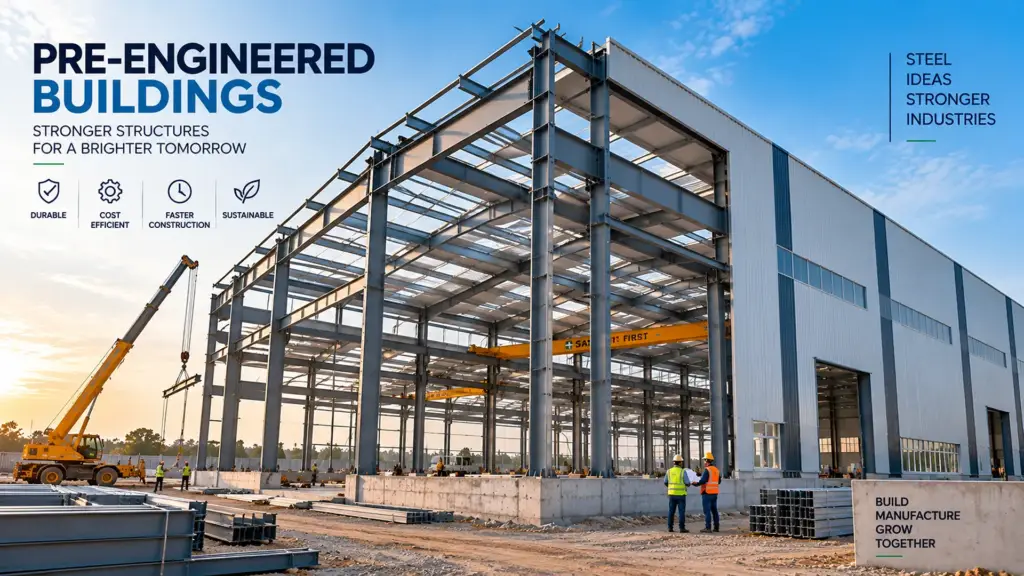
Corrosion is basically steel reacting with moisture and oxygen in the air, and a few things speed that reaction up dramatically. Salt-laden air near the coast carries chloride particles that settle on exposed steel and break down protective layers faster than normal humidity would. Industrial sites add a second layer to this — sulphur dioxide and other airborne chemicals from nearby plants react with steel surfaces in ways that plain humidity doesn’t.
Add in daily and seasonal temperature swings, which cause coatings to expand and contract, and you get micro-cracks that let moisture in over time. This is exactly why generic coating advice doesn’t hold up — anti-corrosion coatings for PEB in coastal/industrial environments have to account for both salt exposure and chemical exposure, often at the same time.
Coastal vs. Industrial Corrosion — Same Result, Different Causes
It’s worth separating these two because they don’t always call for the same response. Coastal corrosion is driven mainly by salt spray and humidity. Industrial corrosion is driven by chemical exposure — and in places like Dahej or Hazira, you’re often dealing with both at once, since these are coastal petrochemical zones. A coating that handles salt spray well doesn’t automatically hold up against industrial chemical exposure, which is exactly why a one-size-fits-all coating recommendation doesn’t really work for Gujarat.
Gujarat Corrosivity Zone Map — What Category Does Your Site Fall Under?
The international standard used to classify corrosion severity is ISO 12944, which ranks environments from C1 (very low, like a heated indoor space) up to C5 (very high, like offshore platforms or heavy chemical plants). Most PEB guides mention this scale and then move on without telling you where your actual site falls. Here’s a practical breakdown for Gujarat:
- C5 — Very High (Industrial): Dahej, Hazira, and the broader Bharuch petrochemical belt. These sites combine coastal humidity with heavy chemical exposure, which is about as aggressive as it gets for structural steel.
- C5 — Very High (Marine): Bhavnagar and other coastal Saurashtra locations, where salt spray is the dominant factor rather than industrial chemicals.
- C4 — High: Ankleshwar and port-adjacent industrial zones, where you get meaningful chemical or salt exposure but not the combined intensity of a C5 site.
- C3 — Moderate: Inland cities like Vadodara, Ahmedabad, and Surat, where humidity and general air pollution are present but without the salt-air or heavy chemical load of the coastal belt.
As a general rule, C5 sites need the strongest anti-corrosion coatings for PEB you can reasonably justify — galvalume with a PVDF finish, or zinc-rich primer systems with a durable topcoat.
C3 sites can usually get by with standard hot-dip galvanized steel and a decent paint system, since the corrosion pressure is much lower. If your site sits somewhere between these — say, an industrial plot 20-30 km inland from the coast — it’s worth getting an actual site assessment rather than guessing, since local factors like prevailing wind direction can push a site into a higher category than distance alone would suggest.
Coating Systems by PEB Component (Not Just “The Building”)
Here’s where a lot of PEB content oversimplifies things. A pre-engineered building isn’t one surface — it’s several different components, each with its own exposure pattern and failure risk. Treating “coat the building” as a single decision means you’re either overspending on parts that don’t need it or underspending on the parts that fail first.
Primary Structural Frame
Columns and rafters carry the building’s load, so failure here is the most serious. In C4 and C5 zones, these typically need a zinc-rich primer as the base layer, an epoxy intermediate coat for chemical resistance, and a polyurethane or PVDF topcoat on top. This three-layer approach is more expensive than a single coat, but it’s the part of the building you really don’t want to under-spec.
Secondary Members
Purlins and girts support the roof and wall sheeting rather than the main load. In C3 zones, standard hot-dip galvanizing under IS 4759 is often sufficient without an additional paint topcoat. In C4/C5 zones, an added paint layer extends their service life meaningfully.
Roof and Wall Cladding
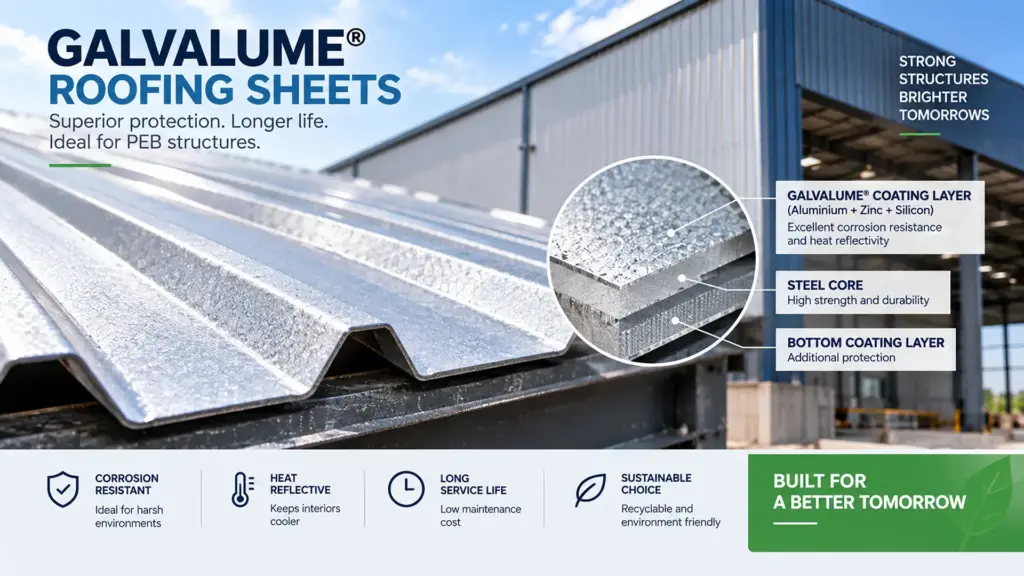
This is the most visible part of the building and the one most exposed to sun and rain. Galvalume sheeting (an aluminium-zinc alloy coating, typically AZ150 or higher) with a PVDF colour coat holds up well against both UV fading and salt exposure, which matters a lot for buildings that need to look presentable for years, not just structurally sound.
Fasteners and Bolts
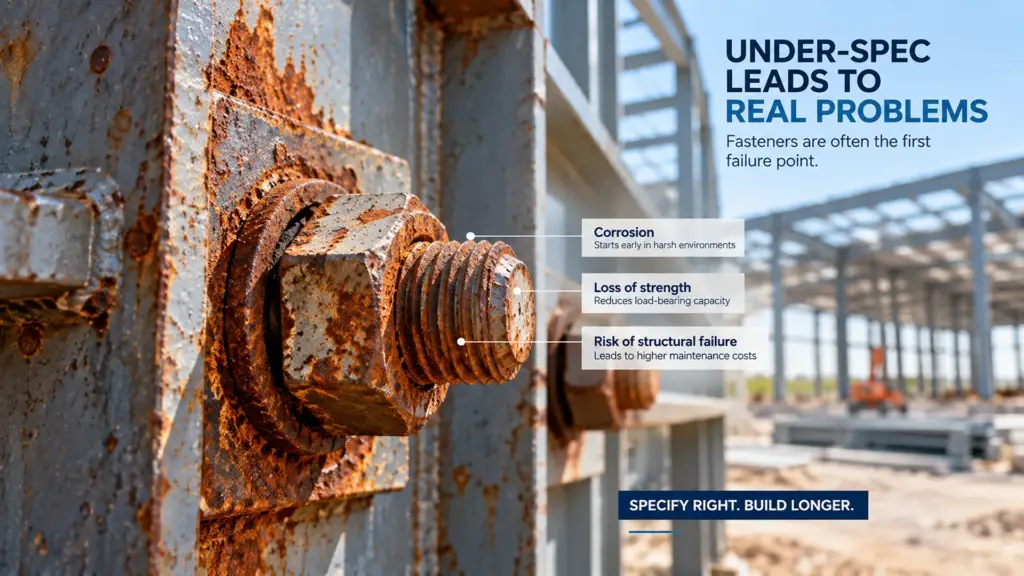
These get overlooked constantly, but they’re often the first visible sign of trouble. A bolt is a small piece of exposed metal at a stress point, and if it’s not properly coated, it can start rusting well before the panels around it show any sign of wear. Hot-dip galvanized or zinc-flake coated fasteners are worth specifying explicitly rather than assuming the vendor’s standard bolts are good enough.
Flashing and Trims
Flashing should match the coating spec of the cladding it sits next to. Mismatched metals in direct contact can trigger galvanic corrosion — where one metal corrodes faster because it’s in contact with a different metal — so this is more about coordination than about picking a fancier coating.
| Component | Recommended Coating (C4/C5 zones) | Recommended Coating (C3 zones) |
|---|---|---|
| Primary frame | Zinc-rich primer + epoxy + PU/PVDF topcoat | Standard galvanized + paint |
| Secondary members | Galvanized + paint topcoat | Galvanized (IS 4759) |
| Roof/wall cladding | Galvalume (AZ150+) with PVDF | Galvalume or standard galvanized |
| Fasteners | Hot-dip galvanized or zinc-flake | Hot-dip galvanized |
| Flashing/trims | Match cladding spec | Match cladding spec |
What Happens When You Under-Spec — A Realistic Timeline
It’s easy to treat coating specs as an abstract line item on a quote. Here’s roughly what under-specced steel in a C5 zone tends to look like over time, compared to a properly coated building:
- Around year 2: The first signs show up at bolt heads and panel cut edges, where the coating is thinnest to begin with. You’ll usually see light surface rust starting at these points before anything else.
- Around year 5: Panel delamination at lap joints becomes more visible, and pitting can start appearing at welds and connection points on the frame — spots where the original coating coverage was often inconsistent.
- Around year 10: Left unaddressed, this can progress to actual section loss on structural members, which means repair or replacement rather than a simple recoat.
A properly specced building, in the same environment, generally shows only minor wear through this same period — mostly cosmetic fading — and stays on a normal maintenance recoat schedule rather than needing structural intervention. The gap between these two outcomes is really the whole argument for getting the anti-corrosion coating spec right at the start rather than treating it as a place to cut costs.
Cost of Ownership — Upfront Spec vs. 15-Year Maintenance Cost
It’s tempting to compare PEB quotes purely on upfront price, but coating spec is one of the biggest hidden variables in long-term cost. A basic tier — standard galvanized steel with a paint system — costs less to install, but in aggressive C4/C5 environments, it typically needs recoating on a shorter cycle to stay protected. A premium tier — galvalume with PVDF, or a full zinc-rich primer system — costs more upfront but generally stretches the gap between major recoats significantly further.
Over a 15-year ownership period, the basic-tier building usually needs more frequent maintenance intervention in a harsh environment, and each of those recoat cycles carries its own labour and material cost, on top of any downtime for the facility. The premium-tier building spreads that cost out further, so even though it starts more expensive, the total cost of ownership in a C5 zone often works out closer than the initial quotes would suggest. If your site sits in a C3 zone, this math shifts — the basic tier holds up reasonably well there, and paying for premium coating may not be worth it. This is really a decision that should follow the corrosivity zone your site falls into, not a blanket choice either way.
Indian and International Standards to Ask Your PEB Vendor About
When you’re comparing PEB vendors, it helps to know which standards actually apply to coating quality, so you know what to ask for in writing rather than taking “corrosion-resistant” as a given:
- IS 4759 — covers hot-dip zinc coatings on structural steel, including minimum coating thickness requirements.
- IS 2629 — recommended practice guidelines for hot-dip galvanizing of iron and steel.
- IS 800 — the general code of practice for structural use of steel in India, which any PEB design should comply with.
- ISO 12944 — the international standard for classifying corrosivity categories and specifying paint system durability, which is what the C1–C5 zones referenced earlier come from.
A credible vendor should be able to tell you which of these apply to your project and show documentation for the coating thickness and process used — not just say “we use galvanized steel” without specifics.
Maintenance and Inspection Checklist Between Recoats
Coating protects the steel, but it’s not maintenance-free — regular checks catch small problems before they become structural ones.
- Every 6 months: Walk the site and check fasteners, panel laps, and any low-drainage areas for early rust bloom — these spots tend to show trouble first.
- Annually: Check flashing seals, gutters, and drainage points for blockages or wear, and look for any coating chips from equipment contact or accidental damage.
- Every 3–5 years in C4/C5 zones, or 7–10 years in C3 zones: Bring in a professional to assess whether a recoat is needed, rather than waiting for visible failure.
None of this requires a specialist for the routine checks — a facility manager doing a basic visual walk-through twice a year can catch most early warning signs before they turn into a bigger repair bill.
FAQs
On its own, standard powder coating isn’t usually enough for C4/C5 coastal zones — it’s better paired with a galvanized or galvalume base rather than used alone on bare steel.
It depends heavily on the specific coating spec and zone, but a properly specced building with an appropriate topcoat generally outlasts a basic galvanized-only building by a significant margin in C4/C5 areas.
Premium systems like galvalume with PVDF cost more upfront than standard galvanized and paint, but the gap narrows over a building’s lifetime in harsh environments because of reduced recoat frequency.
In most cases, recoating is possible if the underlying steel hasn’t already suffered structural section loss. Once corrosion has progressed to that point, recoating alone won’t fix the underlying strength issue.
Getting the right anti-corrosion coatings for PEB in coastal/industrial environments sorted at the design stage is far cheaper than fixing it later. If you’re planning a PEB in Gujarat’s coastal or industrial belt, it’s worth getting a site-specific corrosivity assessment before finalising your building spec — talk to the Devashish Infrastructure team to figure out exactly what your location needs.

