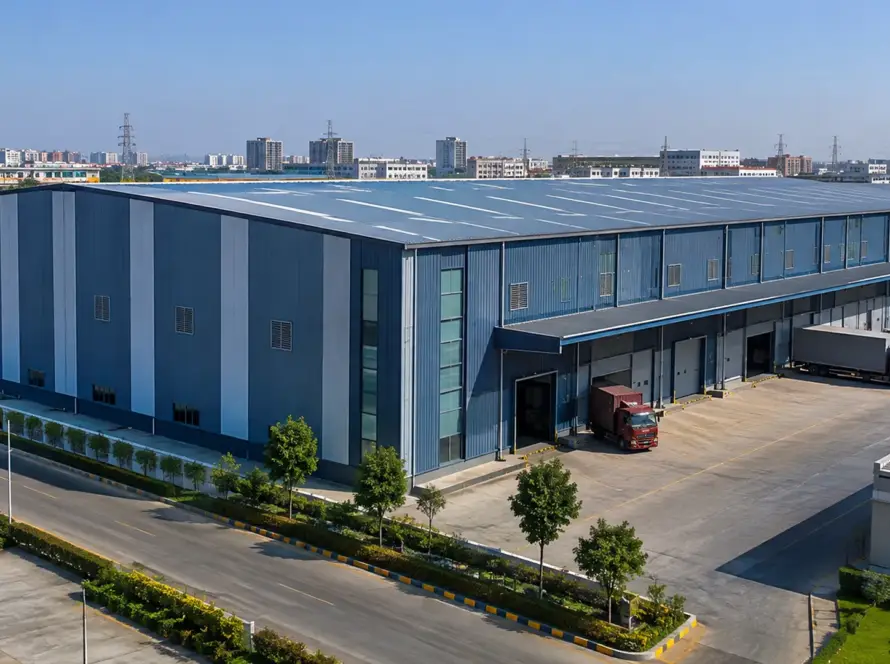
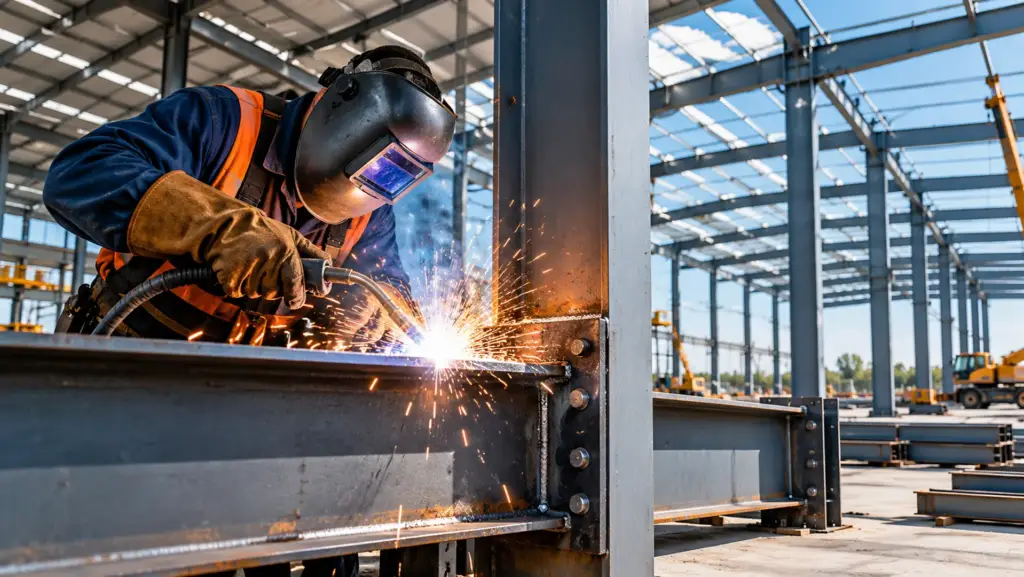
Structural welding is the part of a steel building that nobody sees once the paint goes on, and it’s the part that matters most. Every beam, column and rafter in a PEB, warehouse or industrial shed is held in place by welds, and those welds carry the load all the way down to the foundation. A bad one can look perfectly fine for years. So how do you know yours are good? This guide covers the processes, the codes, the usual defects, how inspection works, and what to ask a fabricator before you sign anything.
What Is Structural Welding?
Definition
Structural welding is the joining of load-bearing steel members so they can carry structural loads safely. It’s done to recognised codes, with approved procedures and qualified welders, so the finished joint behaves the way the engineer designed it, year after year.
How It Differs from General Welding
If you weld a gate or a garden bench, a joint that looks decent is usually good enough. Structural work is a different game. Each weld is designed for a specific load, so size and strength matter far more than looks. The work has to follow a code such as IS 816 or AWS D1.1, and the method is written down and approved before anyone strikes an arc. Then comes inspection, which isn’t optional. The weld is checked, sometimes tested, and only then accepted.
Where Structural Welding Is Used
Anywhere steel carries weight, someone is welding it. Some common examples:
- Pre-engineered buildings: built-up columns and rafters need long, consistent welds.
- Warehouses and industrial sheds: wide spans keep every joint under steady stress.
- Cold storage: the frame has to stay sound in low temperatures and damp air.
- Bridges: traffic loads the welds again and again.
- Crane gantries: moving loads cause fatigue, so there’s very little room for a poor weld.
- Towers: height and wind leave no room for sloppy connections.
- Mezzanines: people, stock and machinery all sit on a steel frame.
Common Structural Welding Processes
People often ask which structural welding process is the best. Honestly, there isn’t one. It depends on the steel thickness, where the work is happening and which weld you’re making.
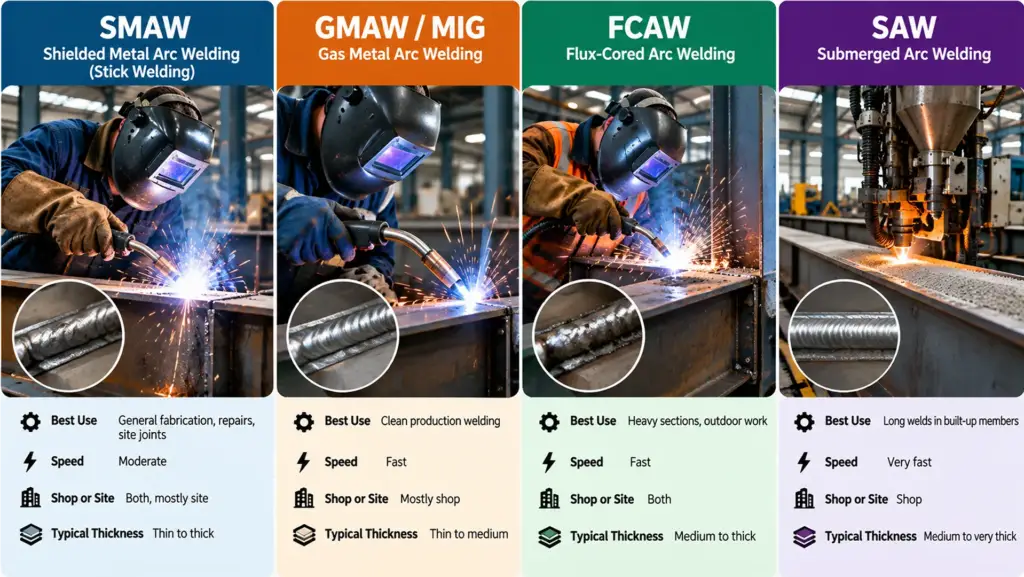
Shielded Metal Arc Welding (SMAW)
This is stick welding, and it’s the one most people picture. It’s versatile, the equipment is simple and portable, and it’s the most common choice for site work. It’s slower than the other options, but when you’re up on a structure far from a workshop, that rarely matters.
Gas Metal Arc Welding (GMAW / MIG)
GMAW is fast and leaves very little slag, so welds come out clean. That makes it a good fit for shop fabrication. The catch is the shielding gas. A bit of wind can blow it away and cause defects, so it’s a weaker choice outdoors.
Flux-Cored Arc Welding (FCAW)
Think of FCAW as the heavy-duty option. It deposits a lot of weld metal quickly, copes well with thick sections, and with the right wire it can be used outdoors too.
Submerged Arc Welding (SAW)
In SAW the arc burns under a blanket of flux, which gives deep penetration and smooth, even beads. It’s used for long, heavy welds in built-up beams and columns, which is exactly what PEB manufacturing needs.
| Process | Best Use | Speed | Shop or Site | Typical Thickness |
|---|---|---|---|---|
| SMAW | General fabrication, repairs, site joints | Moderate | Both, mostly site | Thin to thick |
| GMAW (MIG) | Clean production welding | Fast | Mostly shop | Thin to medium |
| FCAW | Heavy sections, outdoor work | Fast | Both | Medium to thick |
| SAW | Long welds in built-up members | Very fast | Shop | Medium to very thick |
Types of Structural Welds and Joints
Fillet Welds vs Groove (Butt) Welds
A fillet weld is the little triangle of metal you see where two pieces meet at a corner. It’s the most common weld in structural work because it needs hardly any edge preparation. A groove (or butt) weld is different. It fills a prepared gap between two pieces, and you use it when the joint has to carry the full strength of the steel, like in splices.
Groove welds also come in two kinds. Full penetration goes through the whole thickness and is used for critical connections. Partial penetration stops short, which is fine where the load is lower.
Common Joint Types
- Butt joint: two pieces meet end to end in the same plane.
- T-joint: one piece meets another at a right angle, like a stiffener standing on a web.
- Lap joint: two pieces overlap, and the edges are welded.
- Corner joint: two pieces form an L-shaped corner.
- Edge joint: two parallel pieces are joined along their edges.
Materials and Welding Consumables
Most structural steel in India follows IS 2062, usually in grade E250 or E350. The number is the minimum yield strength in megapascals, so E350 is the stronger one.
Your electrodes and filler wire need to suit the base metal. Get that wrong and the weld can end up weaker than the steel around it, which defeats the whole point. On thick sections, low-hydrogen electrodes are worth the extra care. Hydrogen trapped in a weld can cause cracks after it cools, and moisture is where that hydrogen comes from. So these electrodes have to be stored dry.
Structural Welding Codes and Standards
Key Standards
Three standards come up again and again. IS 816 is the Indian code of practice for metal arc welding in general construction in mild steel, published by the Bureau of Indian Standards. AWS D1.1 is the Structural Welding Code for steel from the American Welding Society, and you’ll see it on a lot of international projects. And IS 2062 covers the steel itself, including its grades and properties.
WPS, PQR and Welder Qualification
These three papers are how a fabricator proves they know what they’re doing. A WPS (Welding Procedure Specification) is the written recipe: process, filler, current, preheat and technique. A PQR (Procedure Qualification Record) holds the test results showing that the recipe really produces a sound weld. Welder qualification shows that the person holding the torch has passed a test for that process and position.
As a buyer, ask to see all three. If a fabricator can’t produce them, you’ve got no way of knowing how your welds will hold up.
The Structural Welding Process: Step by Step
Every shop has its own habits, but good structural welding follows roughly this order:
- Drawing and WPS review: check weld sizes, joint types and the approved procedure.
- Edge preparation: cut or bevel the edges, and clean off rust, oil and paint.
- Fit-up and tacking: line the parts up and hold them with small tack welds.
- Preheating (when needed): warm thick or high-strength steel to cut the risk of cracking.
- Welding: lay the weld in the approved sequence so heat and distortion stay under control.
- Cleaning: chip off slag and spatter so nothing hides a defect.
- Inspection: check the weld by eye first, then test it if the job requires.
- Surface protection or painting: coat it only after the weld has been accepted. For coastal or harsh sites, see our guide to anti-corrosion coatings for PEB.
Common Structural Weld Defects and How to Prevent Them
Most defects come down to dirty steel, wrong settings or rushed work. This table shows the usual suspects.
| Defect | Cause | Prevention |
|---|---|---|
| Porosity | Moisture, dirty metal or poor shielding | Clean the surface, keep consumables dry, protect from wind |
| Cracks | Hydrogen, high stress or fast cooling | Use low-hydrogen electrodes, preheat, follow the WPS |
| Undercut | Excess current or wrong travel speed | Adjust settings and use proper technique |
| Lack of fusion | Low heat or poor joint access | Correct current, clean the joint, keep the right angle |
| Slag inclusion | Slag left between weld passes | Clean thoroughly between passes |
| Distortion | Uneven heating and cooling | Use a balanced weld sequence and proper fixtures |
Structural Weld Inspection and Testing
Visual Inspection
This is the first check on every single weld, and it costs almost nothing. A trained inspector looks at the size, shape and surface of the weld, and watches for undercut and cracks. You’d be surprised how many problems show up right here, before any equipment comes out.
Non-Destructive Testing (NDT)
When a weld matters enough, it gets tested without being damaged. The usual methods are:
- Dye Penetrant Testing (DPT): shows surface cracks and pores, on almost any metal.
- Magnetic Particle Testing (MPT): finds surface and near-surface flaws in magnetic steel.
- Ultrasonic Testing (UT): picks up internal flaws like lack of fusion, and works well on thick sections.
- Radiography: gives an image of the inside of the weld, and is used on critical butt welds.
Shop Welding vs Site Welding
Where the weld is made changes a lot. In a shop, welders work indoors with fixtures, good lighting and dry consumables, so quality control and inspection are easier. Rain and wind don’t matter, and automated processes like SAW can speed things up. On site, you’re dealing with weather, awkward positions and slower progress, and each weld usually costs more. Sometimes it can’t be avoided, but the less site welding a structure needs, the better.
That’s why controlled shop fabrication gives PEBs more consistent welds. In a PEB, most of the welding happens in the factory, and the pieces are usually bolted together on site.
How to Choose a Structural Welding and Fabrication Partner
A good fabricator won’t mind being asked questions. Here’s a simple checklist for comparing them:
- Certified, qualified welders
- Documented WPS and PQR
- In-house NDT, or a tie-up with a testing agency
- A proper fabrication facility with the right equipment
- Past projects you can actually verify
- Compliance with codes like IS 816 or AWS D1.1
Planning a steel building? Have a look at our pre-engineered building solutions to see how we handle fabrication and quality checks. If you’re in Gujarat, our page on choosing a PEB manufacturer in Vadodara is a good place to start.
FAQs
There isn’t one best process. SMAW suits site work, GMAW and SAW suit shop fabrication, and FCAW works well for thick sections and outdoor jobs.
Both are strong when done properly. Welding gives rigid, continuous joints, while bolting is quicker on site and needs no heat. Most structures use a mix of both.
A WPS is a written procedure that sets out the process, filler, current, preheat and technique for a weld. Welders have to follow it for the whole job.
IS 816 is the Indian code for metal arc welding in structural steel. AWS D1.1 is also used, especially on projects with international requirements.
Every weld gets a visual inspection first. Critical welds are then tested with NDT methods such as DPT, MPT, ultrasonic testing or radiography.
Conclusion
Structural welding comes down to three things: the right process, the right code and proper inspection. If all three are in place, a steel structure will be safe and last for decades. If one is missing, you won’t always see the problem until much later. Planning a steel building? Get in touch with our team and let’s talk through your project.