Planning a shed, warehouse, or factory in Delhi/NCR? You’re probably stuck on the same four things everyone gets stuck on: what’s this going to cost me, how long is it actually going to take, will the manufacturer show up when they say they will, and does it even matter if they’re based nearby. A decent PEB manufacturer in Delhi/NCR won’t dodge any of that. So that’s what this is. Real numbers where I can give them, the actual process, no brochure fluff.
Why Choosing the Right PEB Manufacturer in Delhi/NCR Matters
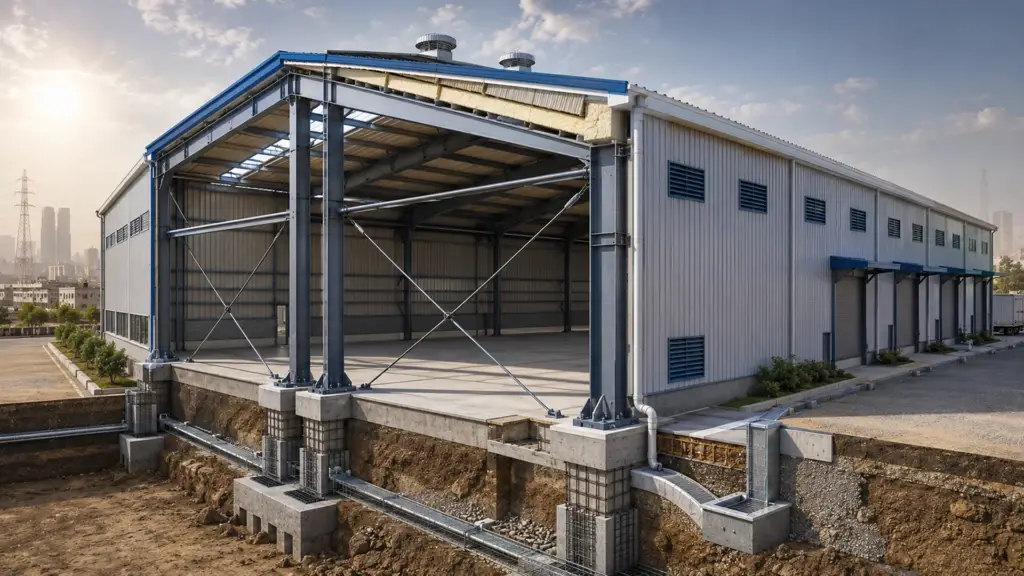
Quick version of what a pre-engineered building is, in case you’re new to this. Most of the structure gets built inside a factory first, not on your land. Columns, rafters, roof sheets, cladding, all of it fabricated to spec somewhere else, then trucked in and bolted together on-site. That’s basically the whole trick. You cut out most of the pouring-concrete-and-welding-in-the-open part of construction, so you’ve got fewer workers standing around when it rains, less wasted material, and a schedule that actually holds up.
Here’s why the manufacturer choice matters so much though. A PEB manufacturer in Delhi/NCR that actually knows this region will build around your real span and load numbers instead of shoving some cookie-cutter design at you because it’s less work on their end. And working with someone local just gets you into the building faster. Not complicated, just true.
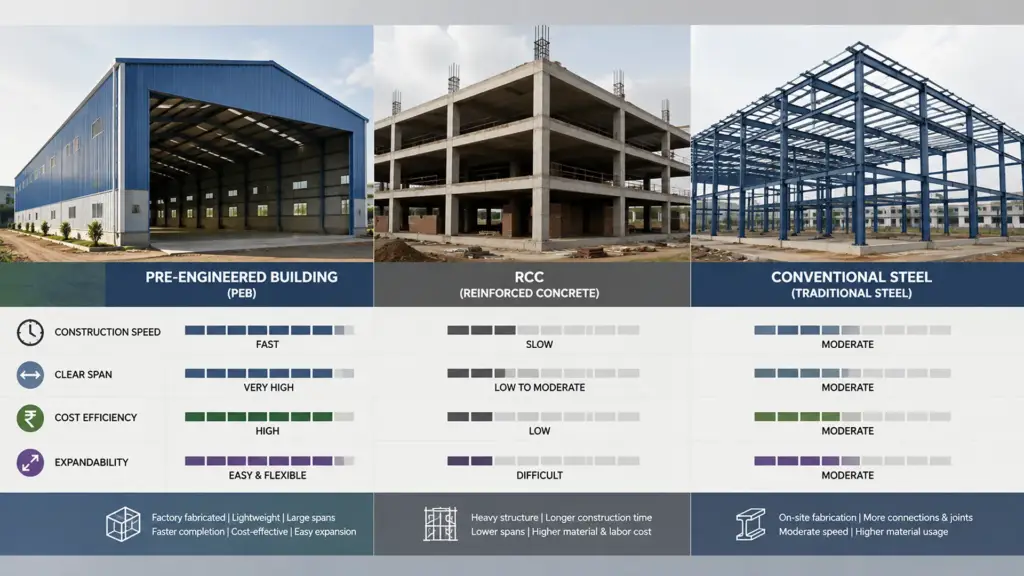
PEB vs RCC vs Conventional Steel: An Honest Comparison
Not going to pretend PEB is right for everything, because it isn’t. But for most sheds and warehouses going up around NCR right now, it’s the better call, and that’s honestly a big reason why finding a good PEB manufacturer in Delhi/NCR has gotten harder as demand’s picked up.
When PEB Wins
- Gets built in weeks, not months
- Long spans with nothing in the middle blocking your layout
- Cheaper per square foot once you’re building at any real size
- Adding on later, extra bays, is genuinely simple
- Puts less weight on your foundation than RCC would
When RCC or Conventional Steel Still Makes Sense
Heavy vibration is where this flips. Running heavy machinery, a press shop, that kind of floor load? RCC’s mass handles it better, plain and simple. Certain fire-rating jobs push you toward concrete too. And a few multi-story buildings, depending on occupancy class and live loads, are just built better in RCC. No point arguing otherwise.
| Factor | PEB | RCC | Conventional Steel |
|---|---|---|---|
| Construction speed | Fastest | Slowest | Moderate |
| Span flexibility | High | Limited | Moderate |
| Cost (large spans) | Lower | Higher | Higher |
| Expandability | Easy | Difficult | Moderate |
| Best for | Warehouses, factories, sheds | High-rise, vibration-heavy use | Custom architectural needs |
Real Cost of a PEB in Delhi/NCR (2026 Breakdown)
This is the part everybody skips straight to, so fine, let’s get into it. Cost swings around based on building type, spec level, and what your site’s actually like. Here’s roughly the shape of it once quotes start coming in from a PEB manufacturer in Delhi/NCR.
Cost by Building Type
A bare-bones shed, no insulation, standard cladding, sits at the bottom of the range. That’s your starting point if budget’s tight. Insulated warehouses run higher, mostly down to PUF panels and the extra cladding work involved. Multi-story PEBs with mezzanine floors sit at the top, and that’s just extra steel tonnage plus more complicated engineering behind it.
I’m deliberately not throwing out fixed ₹/sq ft numbers here. Steel prices move around too much, and honestly, if someone quotes you an exact figure before ever seeing your site, they’re guessing, not calculating. Take whatever number you hear as a rough starting point and get it checked against your drawings and soil report before you believe it.
What Drives the Price
- Steel tonnage — bigger spans and heavier loads need heavier steel sections, and that’s a direct cost hit
- Roofing and cladding grade — single-skin sheeting versus PUF-insulated panels, there’s a real gap here
- Foundation type — bad soil pushes you toward piling instead of simple footings, and your budget feels it
- Erection labor — how tricky the site is and how fast a crew can get set up both matter to labor cost
- Site accessibility — a squeezed-in site near Delhi costs more to erect on than open land out in Bhiwadi or Sonipat
A manufacturer worth your money walks through every one of these with you instead of just handing over a single figure and expecting you to nod along. If somebody quotes a fixed price without ever visiting or asking for a soil report, that’s not confidence talking. That’s a guess with a rupee sign on it.
Designing for Delhi/NCR Conditions: Not Just “Durable”
Every manufacturer will tell you their buildings are durable. Sure. What actually counts is whether the design was built around what NCR specifically throws at a structure, and this is exactly where a genuinely local PEB manufacturer in Delhi/NCR earns their fee, because you can’t plan around these conditions from three states over.
Seismic Zone IV
Most of Delhi/NCR sits in Seismic Zone IV, which is a high-risk zone under Indian codes. That number decides column spacing, where bracing goes, and how the foundation deals with lateral load. Take a design meant for a calmer seismic zone and drop it into NCR without touching anything, and you’ve got a real problem waiting to happen. Column spacing and bracing have to be worked out for Zone IV specifically, not patched up afterward and called good enough.
Summer Heat and Roof Insulation
NCR summers get harsh enough that roof surface temperatures make insulation basically mandatory for any space people are actually working in day to day. PUF sandwich panels are the standard choice for that, and pairing them with ridge or turbo ventilators means hot air actually leaves the building instead of pooling near the roofline all afternoon.
Monsoon Drainage and Pollution-Resistant Cladding
Monsoon rain here doesn’t ease in. It dumps, hard, in short windows, so roof slope and gutter sizing need to be built around peak flow, not some gentle average that looks nice on paper. Then there’s the dust and pollution angle, which wears through cladding coatings faster than you’d see in cleaner-air regions. That’s exactly why coating grade, galvalume or a higher-spec paint system, is a real engineering decision, not just a color choice you make at the end.
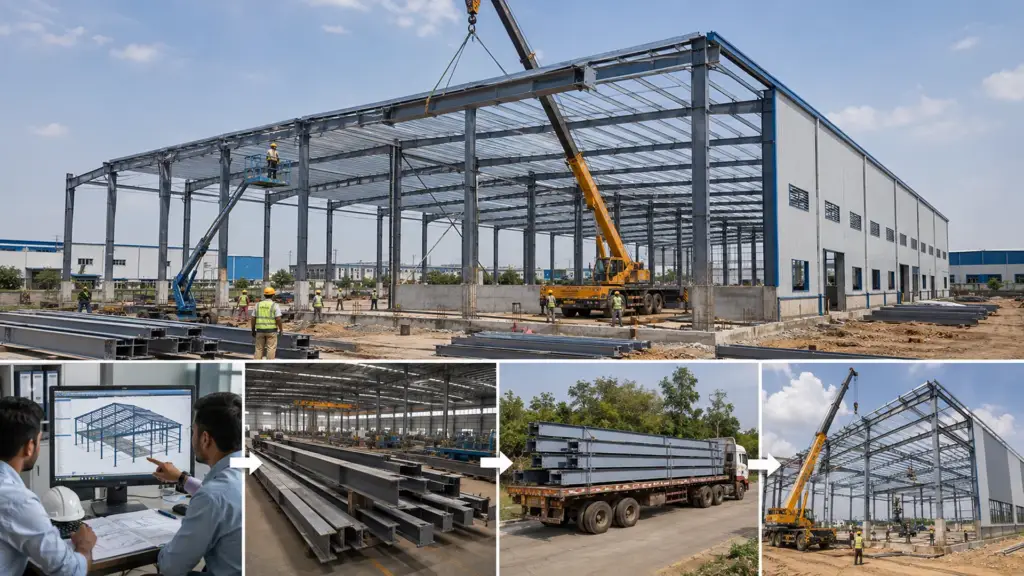
From Inquiry to Handover: Our Process as a PEB Manufacturer in Delhi/NCR
A typical project here takes about 90 days start to finish. Roughly, here’s how that breaks down.
Week 1–2, Site Survey and Soil Testing. Engineers come out, pull soil samples, check what access looks like, flag whatever’s going to be a problem before anyone even starts drawing.
Week 3–5, Design, Engineering and Approval. Structural drawings get locked, and where it’s needed, we handle the back-and-forth on municipal or authority approvals.
Week 6–10, Fabrication Lead Time. Steel gets cut, welded, prepped at the plant while foundation work on your end usually runs alongside it.
Week 11–13, Transport and On-Site Erection. Everything gets trucked over, and the erection crew puts it all together on-site.
Common Delays and How We Avoid Them
Here’s the part nobody likes admitting. Fabrication almost never causes delays. It’s approvals and weather, basically every single time. Municipal timelines stretch without any real warning, and monsoon months, roughly July through September, slow down both foundation work and erection. There’s no clever fix for that beyond being honest about it upfront. You build buffer time into the schedule around those windows instead of promising a clean 90-day run that rain or paperwork is going to mess with anyway.
Where to Build: Land and Zoning Across NCR’s Industrial Belts
Where your plot sits affects both what you pay for land and how smoothly the whole build goes.
Key Industrial Corridors
Bhiwadi’s been around long enough to have solid infrastructure and an ecosystem that actually functions. Neemrana’s newer, growing quickly, and usually easier on land cost. Manesar connects well into Gurugram and Delhi, which is why auto-ancillary manufacturers gravitate there. Sonipat’s coming up fast, with highway connectivity that keeps getting better. Faridabad’s older but has supporting infrastructure already in place. Greater Noida’s expanding quickly, with newer planned industrial zones.
Land rates shift around constantly here, so check current numbers with someone local rather than trusting whatever figure you found floating around a few months back.
Why Proximity to Your Fabricator Matters
The closer your site is to the plant, the less you’re paying in transport and the faster a crew can actually get there to erect it. It also cuts down transit damage, because long hauls over rough NCR roads mean a real chance of dents or misaligned pieces that then need fixing right on-site, eating into your schedule. It’s one more reason a real PEB manufacturer in Delhi/NCR usually beats someone shipping components in from halfway across the country.
Life After Installation: Maintenance and Longevity
Most industrial buyers are thinking 15, 20 years down the line, so what happens after handover matters just as much as the build did.
Corrosion Management in NCR’s Pollution and Dust Conditions
NCR’s air quality and dust wear down coatings faster than you’d see in cleaner regions. Regular cleaning of cladding and structural steel, and catching coating damage early instead of letting it sit, keeps corrosion from getting a real foothold.
Recoating Schedule and AMC Options
Recoating usually runs on a multi-year cycle rather than every year, depending on which coating system got used originally. A lot of manufacturers, us included, offer Annual Maintenance Contracts covering inspection, touch-up coating, and structural checks. If you’d rather know your upkeep costs ahead of time than get hit with surprise repairs later, bring it up early. Not after year five when something’s already gone wrong.
Proof, Not Just Claims: Recent NCR Projects
Generic claims don’t really tell you anything useful. What actually helps is specifics, building type, location, size, how long it actually took. When you’re checking out a PEB manufacturer in Delhi/NCR, ask for two or three recent projects with those exact numbers, including real delivery time against whatever got promised at the start. A manufacturer confident in their record hands this over without blinking. One who stalls on it is telling you something too, whether they mean to or not.
FAQs
Around 90 days on average, site survey to handover, though building complexity, approval timelines, and monsoon scheduling can stretch that further.
Most PEB manufacturers help with drawing prep and approval coordination, but exactly how much they take on varies a fair bit between companies. Ask directly before signing anything.
Comes down to the manufacturer’s factory capacity and what fabrication run actually makes sense for them. Just ask directly for their current minimums.
Yes, and that’s genuinely one of the better things about PEB. You can usually add bays along the length down the line, as long as the original design accounted for it from day one.
Get a Quote
Looking for a PEB manufacturer in Delhi/NCR you can actually count on for a real deadline? Call us or fill out the quote form, and we’ll get a site visit set up and put together a proper cost estimate based on your actual land, not a guess pulled out of thin air.