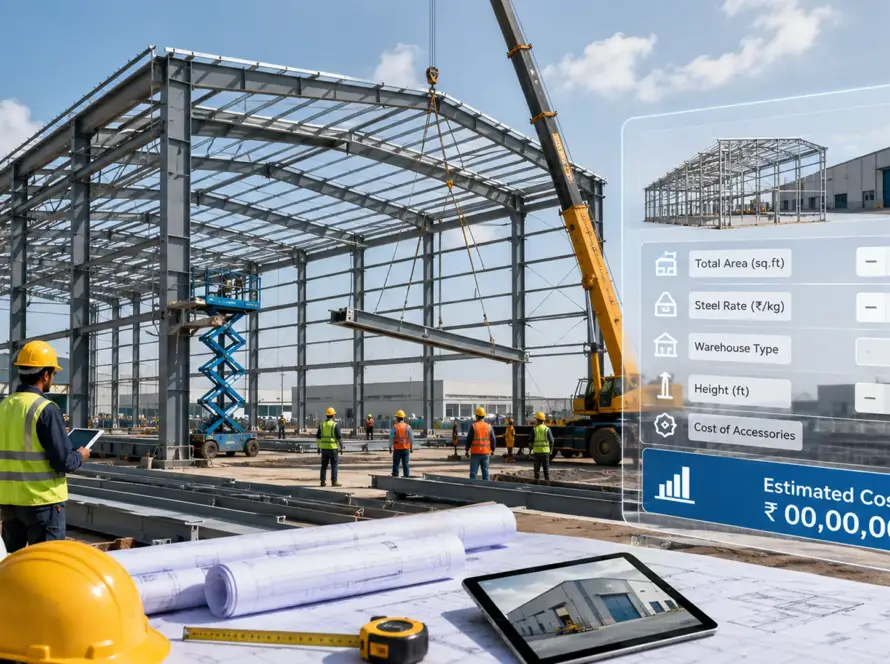
Here’s the thing about most PEB manufacturer in Nagpur websites — they all sound alike. Confident, vague, and light on actual numbers. We wanted this page to be different, so it’s built around what you’d actually ask us on a site visit: what does this cost, how long will it take, what could go wrong with the soil or the approvals. If you’re weighing a few PEB manufacturers in Nagpur right now, treat this as a checklist more than a sales pitch.
What Is a Pre-Engineered Building (PEB)?
A PEB starts life far away from your plot. The steel frame is designed and cut at a factory, then trucked over and bolted together on site. You skip the slow part — no laying brick column by column, no standing around waiting for concrete to cure. Primary framing (your columns and rafters) and secondary framing (purlins, girts, bracing) turn up pre-drilled and ready to go up. Because so much happens before anyone even reaches the site, erection itself moves fast. Everything’s already been worked out around your span, your height, your load — long before the steel gets cut.
PEB Applications We Build in Nagpur
One PEB design doesn’t fit every job, and honestly it shouldn’t. What you’re using the building for changes nearly everything underneath the hood.
- Industrial sheds — wide clear spans so equipment and machinery can move without bumping into columns. Roof design cares more about airflow and daylight than keeping heat in.
- Warehouses & logistics facilities — floor loading is the number that matters most, especially once forklifts and racking enter the picture. Buildings tend to go taller too, so you get more cubic storage out of the same footprint.
- Factory/production buildings — clear span for the line, plus room worked in for cranes, mezzanines, and whatever electrical, air, or ducting the process needs.
- Cold storage & specialized structures — insulation basically drives the whole design here, along with vapor barriers and flooring that can take constant cold without breaking down.
Change what the building’s for, and the steel sections, bay spacing, and cladding all shift with it. Talk to any real PEB manufacturer in Nagpur and they’ll ask what’s going inside before they ask how big you want it.
PEB Construction Across Nagpur’s Industrial Belt
Butibori MIDC, Hingna, Kalmeshwar & Wardha Road Corridor
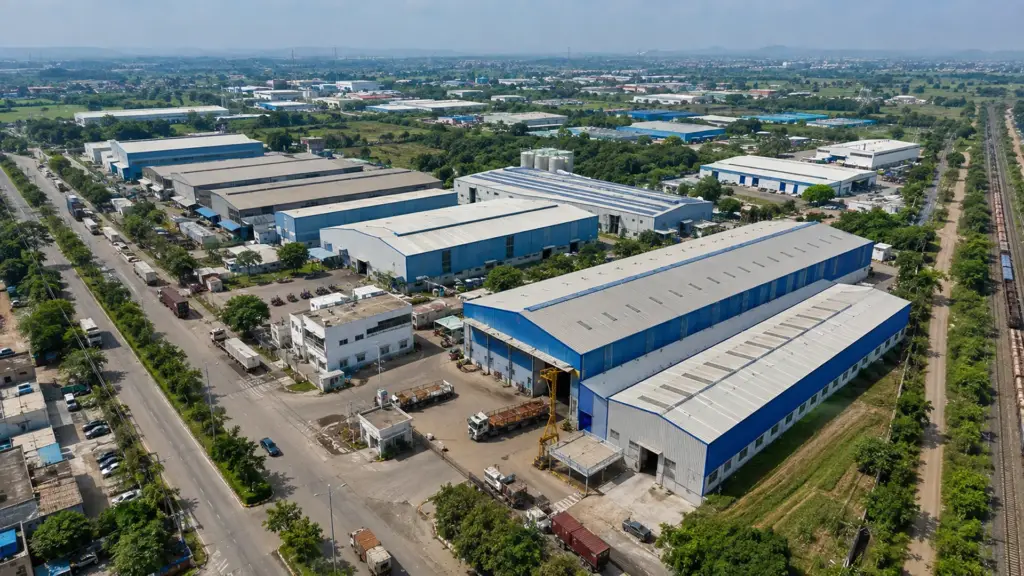
Nagpur’s industrial map isn’t one blob — each belt has grown its own character over time. Butibori MIDC is the heavyweight, the largest industrial zone in the region, packed with manufacturing, auto ancillary, and processing units all working side by side. Hingna MIDC is the older cousin, dense with smaller and mid-sized units that have been operating there for years. Kalmeshwar built up quietly around agro-processing and warehousing, helped along by the cotton and grain trade sitting right nearby. The Wardha Road corridor picked up logistics and light industrial work mostly because moving trucks in and out is simple.
What ties it all together is connectivity. NH44 runs straight through — it’s one of the longest national highways in India — and the Nagpur–Mumbai Expressway genuinely changed how freight moves toward the west. Add the rail freight terminal and MIHAN’s air cargo capability into the mix, and it stops being a mystery why warehousing keeps expanding in these zones.
Local Site Factors That Affect Your PEB Design
Soil isn’t the same across town. Some plots sit on murrum or rocky ground, while land closer to rivers needs deeper foundation work, and that alone can move your budget more than most people expect going in. On the seismic front, Nagpur falls in Zone II, so it’s on the safer end nationally, but wind load actually plays a bigger role in the design here than earthquake load does. Then there’s paperwork, which nobody enjoys but can’t be skipped. MIDC plots run on their own set of building norms, and layout approval, fire NOC, and permissions need to get moving well before fabrication starts, not once it’s already underway. We’ve watched projects lose two or three weeks purely because approvals got pushed to “later.”
PEB Cost in Nagpur — What ₹/sq.ft. Actually Gets You
Key Cost Drivers
There isn’t one number that covers every PEB job. A handful of things push the price around:
- Steel grade and tonnage — switching to something like Fe 350 over Fe 250 cuts down tonnage but pushes up the per-kg rate.
- Clear span width — wider spans need heavier primary framing, so more steel goes in overall.
- Roof and wall cladding type — plain single-skin sheeting is the cheapest route. Insulated or double-skin panels cost more.
- Floor and foundation work — soil type, load requirements, foundation depth. This is usually where the biggest swing happens.
- Site preparation — leveling, compaction, access roads. Small line items that add up fast.
Indicative Price Ranges by Structure Type
Use this as a starting point, not a final quote. Prices move with site conditions, spec, and steel rates on the day you buy — so get an itemized number before locking anything in.
| Structure Type | Indicative ₹/sq.ft. Range | Typically Included | Typically Excluded |
|---|---|---|---|
| Basic industrial shed | ₹550 – ₹800 | Steel structure, standard sheeting, basic flooring | Insulation, MEP, compound wall |
| Warehouse | ₹700 – ₹1,000 | Structure, cladding, higher floor loading | Racking systems, dock levelers, fire systems |
| Factory/production building | ₹850 – ₹1,300+ | Structure, cladding, crane provisions | Machinery foundations, process utilities, HVAC |
What Adds to the Cost (Hidden Extras Buyers Miss)
This is usually where a quote that looked great on paper stops looking so great. Keep an eye on:
- Insulation (PUF panels or fiberglass) for temperature control
- Crane systems or mezzanine floor structures
- Fire compliance — sprinklers, hydrant systems, fire-rated doors
- Electrical and MEP work
Ask for an itemized quote, every time, no exceptions. If a manufacturer won’t break the number down, that’s worth noticing.
Technical Specifications & Standards We Follow
IS Codes & Structural Compliance
The structural side runs on IS 800 for steel construction and IS 875 for design loads, covering dead load, live load, wind load, and snow load wherever it’s relevant. Wind ends up mattering more here than people assume, given how exposed Nagpur gets during certain seasons, and it’s built into the design right alongside the Zone II seismic rating.
Span, Load Capacity & Steel Grades
| Parameter | Typical Range |
|---|---|
| Clear span | 15m – 60m (project dependent) |
| Eave height | 4m – 12m+ |
| Steel grades | Fe 250, Fe 350, and higher-grade options |
| Roof live load | As per IS 875, site and use-specific |
What works best comes down to purpose, plain and simple. A warehouse loaded up with racking needs a different load profile than a shed built around heavy machinery, and treating those two the same is a mistake we see fairly often.
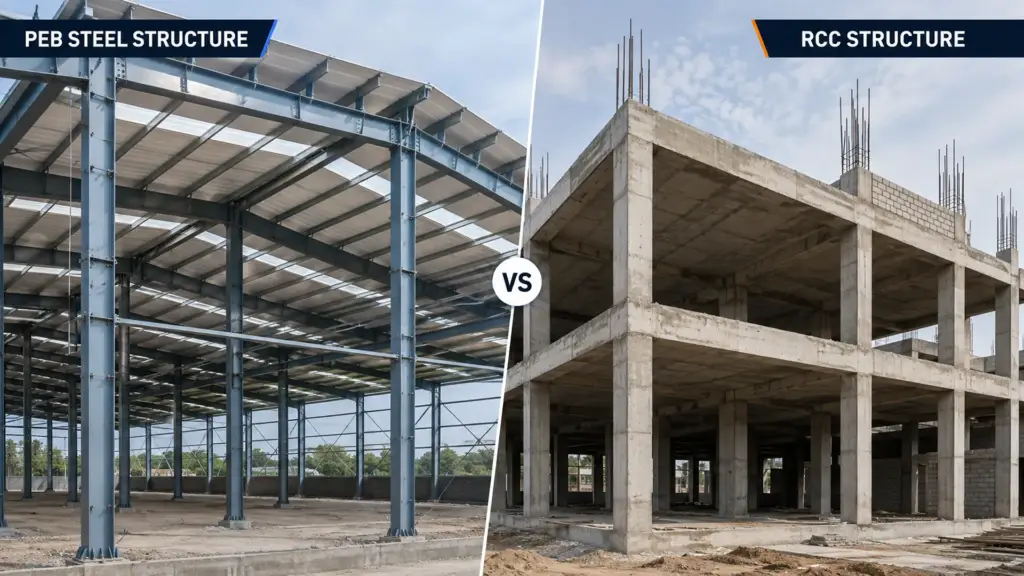
PEB vs. RCC Construction — Which Is Right for Your Nagpur Project?
| Factor | PEB | RCC |
|---|---|---|
| Construction timeline | Faster — weeks to a few months | Slower — several months to a year+ |
| Cost per sq.ft. | Generally lower for large spans | Generally higher, especially at scale |
| Durability | Strong with proper maintenance | Very durable, long design life |
| Maintenance | Periodic — cladding, paint, fasteners | Lower, but repairs can be more disruptive |
| Resale/scalability | Easy to expand or modify | Harder and costlier to expand |
| Ideal use cases | Sheds, warehouses, factories, large clear spans | Multi-story buildings, offices, residential |
For big, single-story industrial spans, PEB wins on speed and cost pretty clearly. That’s just how the math plays out. RCC still has a role though, particularly for multi-story buildings, projects chasing decades of life with barely any steel upkeep, or places where local norms simply favor concrete. Worth a real conversation with your structural consultant before you write either option off.
Timelines — How Long Does a PEB Project Take?
Size and complexity do most of the work in setting your timeline. Rough numbers to plan around:
- 10,000 sq.ft. shed — Design and approval: 2–3 weeks. Fabrication: 3–5 weeks. Erection: 2–3 weeks. Total: roughly 2–3 months.
- 30,000 sq.ft. warehouse — Design and approval: 3–4 weeks. Fabrication: 6–8 weeks. Erection: 4–6 weeks. Total: roughly 4–5 months.
Bigger factory projects with cranes, mezzanines, or unusual flooring push these numbers out further. The projects that hit their schedule are almost always the ones where site prep and approvals happen alongside fabrication, not after it’s finished.
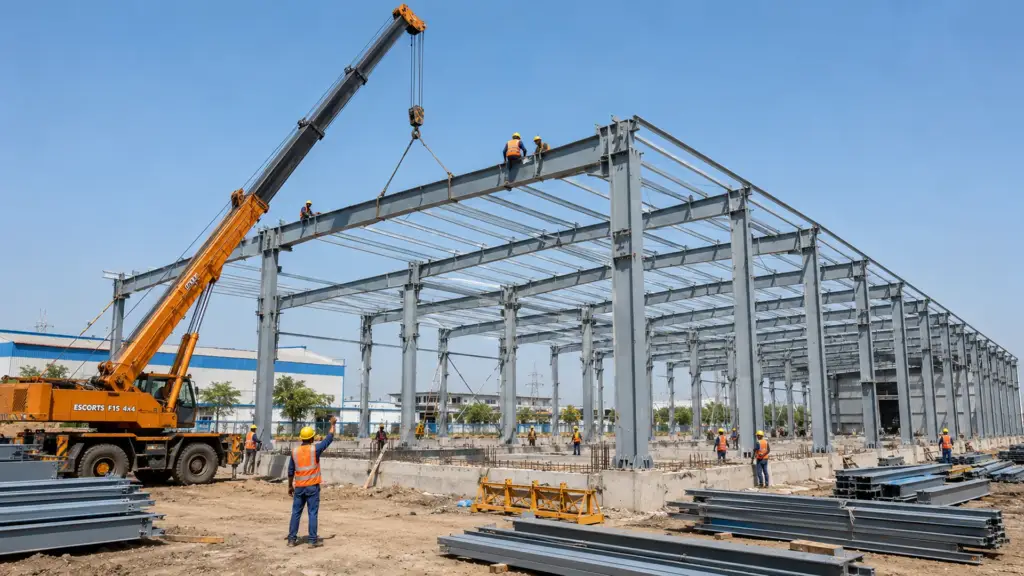
Real PEB Projects Delivered in Nagpur
Every job has its own wrinkles, but this gives a fair picture of the scale a PEB manufacturer in Nagpur usually handles:
| Sector | Approx. Size | Zone | Typical Completion Time |
|---|---|---|---|
| Auto ancillary manufacturing shed | 15,000 – 20,000 sq.ft. | Butibori MIDC | ~3 months |
| Warehousing & distribution | 25,000 – 35,000 sq.ft. | Wardha Road corridor | ~4-5 months |
| Agro-processing unit | 10,000 – 15,000 sq.ft. | Kalmeshwar | ~2-3 months |
| Light engineering factory | 12,000 – 18,000 sq.ft. | Hingna MIDC | ~3-4 months |
Ask for references if you can, and better yet, walk a finished site yourself. Twenty minutes there tells you more than any brochure will.
Frequently Asked Questions
Not a lot. A yearly look at the roof sheeting, fasteners, and paint or coating usually covers it.
Yes. Standard fire and structural policies treat PEB the same way they’d treat an RCC building.
Yes, and it’s one of the better things about going PEB. Extra bays can usually be tacked onto the end, as long as the original design left room for it.
Most banks and NBFCs will finance PEB along with other industrial construction, but terms vary by lender and by project. Worth checking directly with your bank rather than assuming.
Warranty terms differ by manufacturer, and structural steel is usually covered separately from cladding. Get whatever’s promised in writing before you sign.
Yes, as long as it’s designed to IS 875 wind and load standards. PEB handles Nagpur’s summer heat and monsoon rain just fine, provided drainage and roof slope are done properly.
Generally layout approval, building plan sanction, and fire NOC through local or MIDC authorities. What exactly you need depends on the zone, so confirm early instead of guessing.
Get a Quote From a Trusted PEB Manufacturer in Nagpur
Want a real number instead of a rough guess? Send us your plot size, location or zone, and what the building’s actually for — shed, warehouse, factory, or cold storage. We’ve built across Butibori, Hingna, Kalmeshwar, and the Wardha Road belt, so we can give you an honest range and a timeline you can actually plan around, not a generic figure pulled from nowhere. Reach out through the contact form, or just call.