


Walk into a shed in peak summer and you’ll know the problem straight away. The air is hot and heavy, the exhaust fans are running flat out, and the power bill keeps climbing. Then the monsoon arrives and rain starts blowing in through the vents. Metal louvers are often the simplest way out of both problems. They’re angled metal blades fixed in a frame, and they let air in while keeping rain and debris out. Below, we’ll cover the types, the materials, the specs worth checking, what drives the cost and how to pick a supplier.
What Are Metal Louvers?
Metal louvers are angled metal blades fixed in a frame that let air and light in while keeping rain, sun and debris out. You’ll see them on sheds, plant rooms, factories and commercial buildings.
So how do they actually work? It’s all in the blade angle. The slope lets air slip through the gaps, and it also pushes rain and direct sun away from the opening. A well-designed blade sends water outward too, so the wet doesn’t travel inside.
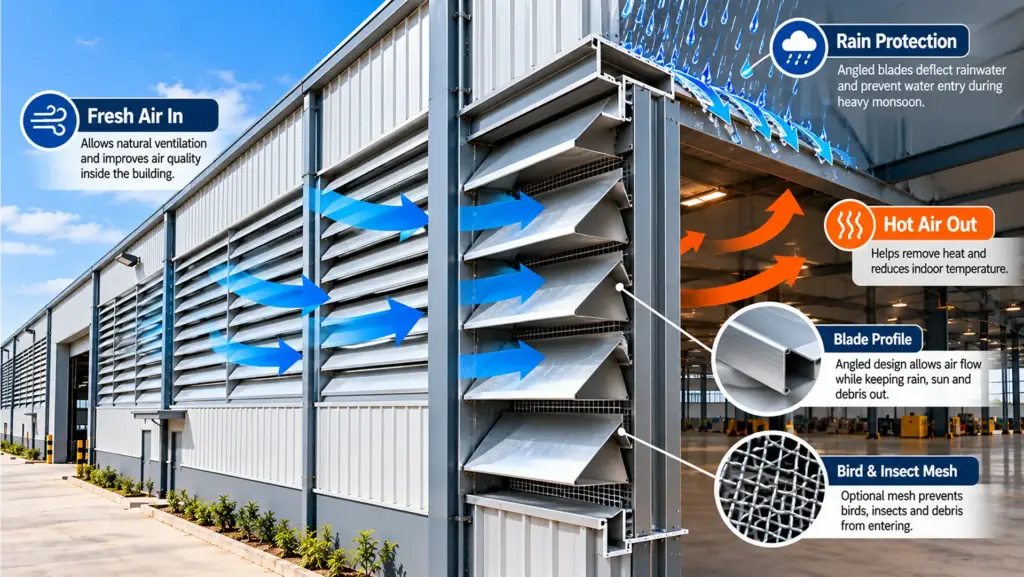
You’ll find them in a few common forms. Some mount on walls, some fit into doors, and others sit on the roof or ridge. The blades look alike, but the setup changes from one use to the next.
In a big shed, this matters a lot. Hot air rises and collects under the roof, and if it has nowhere to go, the whole space gets uncomfortable. Metal louvers give that air a path, which is why they show up on so many industrial buildings.
Types of Metal Louvers
Not every louver does the same job. The right one depends on what you need to block, what you want to let through and where the building stands.
Fixed Louvers
The blade angle on these never changes. That means very little maintenance, and it’s why fixed louvers are the most common choice for sheds and plant rooms.
Adjustable (Operable) Louvers
You can turn the blades on these, by hand or with a motor, to control airflow and light. They’re popular in commercial buildings and in places where the weather swings a lot.
Stormproof / Weather Louvers
Heavy monsoon rain needs a tougher design, and that’s where these come in. They use deep blades or drainable profiles to handle the water. If rain is your main worry, ask the supplier for the water penetration rating, which shows how well the louver keeps water out. Louvers are commonly tested for water penetration and airflow under standards such as AMCA 500-L, so ask whether test data is available.
Acoustic Louvers
Acoustic louvers carry sound-absorbing infill. As a result, they suit DG sets, compressor rooms and HVAC equipment, where you need airflow but don’t want the noise leaking out.
Architectural / Sunscreen Louvers
Think of these as shading for the facade. They cut heat gain, and they make the building look better too.
Door and Wall Louvers
These are small louver panels for electrical rooms, stores and service shafts. They’re simple and compact, so they fit easily into existing walls.
Plenty of buildings use more than one type. A plant might have stormproof louvers on the outer walls, acoustic louvers on the DG room and small door louvers on the electrical rooms.
Metal Louver Materials Compared
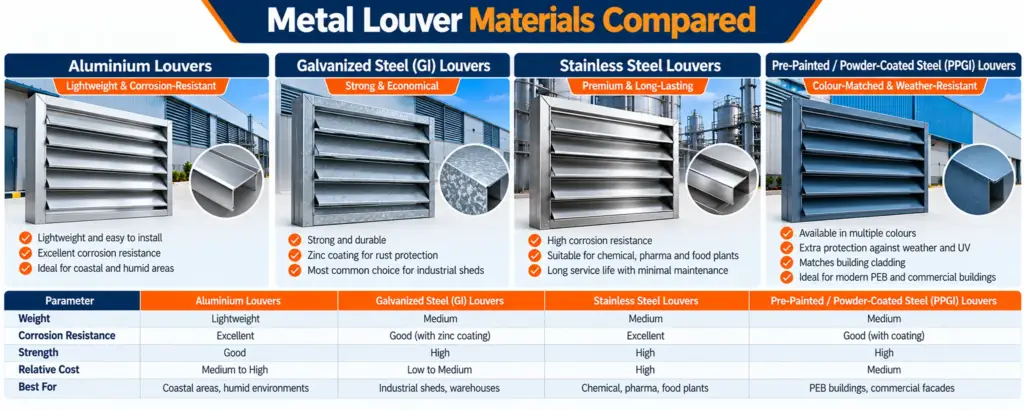
Material decides how long a louver lasts, how it looks and what it costs. Here’s how the main options stack up.
Aluminium Louvers
Aluminium is light and resists corrosion, so it works well in coastal and humid areas.
Galvanized Steel (GI) Louvers
GI is strong and economical, and it’s the usual choice for industrial sheds.
Stainless Steel Louvers
Stainless steel is the premium pick. Chemical, pharma and food plants often choose it because it copes with harsh conditions and frequent cleaning.
Pre-Painted / Powder-Coated Steel (PPGI)
PPGI can be colour-matched to your cladding, and the coating adds a bit of weather protection.
| Material | Weight | Corrosion Resistance | Strength | Relative Cost | Best For |
|---|---|---|---|---|---|
| Aluminium | Lightweight | Excellent | Good | Medium to high | Coastal areas, humid environments |
| Galvanized steel (GI) | Medium | Good (with zinc coating) | High | Low to medium | Industrial sheds, warehouses |
| Stainless steel | Medium | Excellent | High | High | Chemical, pharma and food plants |
| PPGI | Medium | Good (with coating) | High | Medium | PEB buildings, commercial facades |
The short version? GI is the practical choice for most industrial sheds. Aluminium makes sense near the coast or in humid areas, and stainless steel earns its extra cost where hygiene or chemicals are involved.
Where Are Metal Louvers Used?
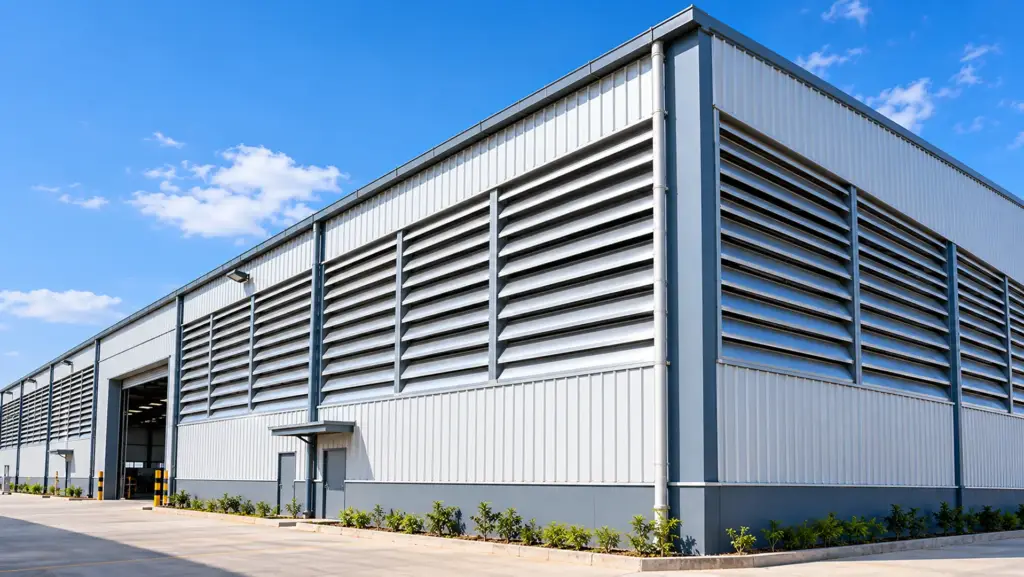
Anywhere a building needs to breathe, you’ll probably find metal louvers. Here are the main places, and why they matter in each.
- Industrial sheds and PEB buildings: hot air gets out and fresh air comes in, so the work area stays bearable.
- Warehouses and logistics hubs: stored goods don’t sit in stale, humid air.
- Factories and manufacturing plants: they help clear heat and fumes from the floor.
- DG rooms, electrical and transformer rooms: the equipment runs hot, so it needs a steady supply of air.
- Multi-level parking structures: the space stays ventilated without being closed off.
- Commercial facades and HVAC plant rooms: the equipment stays hidden, but air still flows.
In every one of these places the job is the same: keep air moving and keep the weather out.
Key Specifications to Check Before Buying
Two louvers can look identical and perform very differently. That’s why it pays to check these before you buy:
- Free area %: how much open area is available for airflow.
- Blade profile and angle: Z-type, chevron or drainable.
- Sheet thickness or gauge: this affects strength and durability.
- Water penetration and airflow performance: critical during the monsoon.
- Finish: mill finish, anodized, powder-coated or pre-painted.
- Frame, fixing method and bird or insect mesh: these decide how well it holds up and what stays out.
Free area and rain protection often pull in opposite directions. A deeper, more rain-resistant blade usually cuts the open area, while a more open design lets in more air and more rain. Good selection balances the two for your site, so tell your supplier about your local weather and how much airflow you need.
Tip: match the spec to the application instead of comparing price alone. A cheaper louver that lets rain in costs more in the end.
Benefits of Metal Louvers
- Natural ventilation: it lowers exhaust fan and power costs.
- Less heat: sheds stay cooler inside.
- Protection: rain, dust and birds stay out.
- Long life: they need very little upkeep.
- Better looks: the building looks cleaner and more professional.
Louvers work best as part of a ventilation plan. On their own, they let fresh air in at the sides, but hot air still needs a way out at the top. That’s where industrial ventilators come in, since the two together keep air moving through the whole building.
What Affects the Cost of Metal Louvers?
Prices change a lot from one project to the next, so we won’t quote fixed rates here. Instead, here are the things that move the price:
- Material and thickness
- Size and quantity
- Blade type, whether fixed or adjustable, standard or stormproof
- Finish and colour
- Customization, plus installation height and complexity
Since every building is different, the best way to get a real number is to request a custom quote with your sizes and requirements.
Installation and Maintenance Tips
Even a good louver can fail if it’s fitted badly. So keep these points in mind:
- Fit it the right way up, so rain drains outward.
- Seal properly between the louver frame and the wall or cladding.
- Add mesh to keep birds and insects out.
- Clean off dust build-up from time to time.
- Inspect after the monsoon for corrosion or loose fixings.
It also helps to plan the louver positions early, while the building is still on paper. You can fit louvers after the cladding is up, but it’s easier and neater when the openings are designed in from the start.
How to Choose the Right Metal Louver Supplier
The supplier matters as much as the product. Here’s what to look for:
- In-house manufacturing and customization
- Experience with industrial and PEB projects
- Material certificates and good finish quality
- Site measurement and installation support
- Clear delivery timelines and after-sales service
Don’t be shy about asking for a sample, or for photos of similar projects. A supplier who’s confident in the product will usually be happy to show you.
If you’re building a new shed, take a look at our pre-engineered building solutions and our roof and wall cladding solutions, so ventilation and cladding get planned together.
FAQs on Metal Louvers
Neither wins every time. Aluminium is lighter and resists corrosion, so it suits coastal and humid sites. GI is stronger and more economical, which makes it the usual choice for industrial sheds.
Stormproof or weather louvers with drainable blades block most wind-driven rain. Standard fixed louvers reduce it but may let some in during heavy storms, so ask your supplier for water penetration test data.
It depends on the material, finish and environment. With a good coating and regular cleaning, they can last for many years. Aluminium and stainless steel usually resist corrosion better than basic GI.
In most cases, yes. Suppliers can make louvers to custom sizes, though very large openings are usually split into panels for strength and easy handling. Share your exact opening sizes early.
Sometimes, but not always. Louvers work best alongside roof ventilators, which let hot air escape at the top while the louvers bring in fresh air. Heat-heavy processes may need fans too.
Louvers are angled blades fitted in walls, doors or openings, and they allow airflow while blocking rain. Ventilators, usually on the roof, extract hot air. Many sheds use both together.
Conclusion
The right metal louvers depend on your application and your climate. Match the type and material to the job, check the specs, and you’ll get better airflow and fewer leaks for years. Ready to fix your shed’s ventilation? Request a quote, book a site visit or ask about a custom size. If you’re in Gujarat, start with our page on choosing a PEB manufacturer in Vadodara.

