India just produced a record 353.96 million tonnes of foodgrain in 2024-25. That’s a huge number, and on paper it sounds like good news. But here’s the problem: the country’s existing covered storage capacity sits at around 92 million metric tonnes, and that infrastructure is now stretched to its limit.
More grain is coming in every year, and there simply isn’t enough safe, scientific storage to hold it. This is exactly why demand for PEB for agro-processing and grain storage units has grown so fast across India, and especially in agriculture-heavy states like Gujarat.
Most content on this topic treats grain storage and agro-processing as the same thing. They’re not. A structure built to store grain and a structure built to process it need very different things from their design. This guide breaks down both, explains what actually goes into a well-planned PEB for agro-processing and grain storage units, and looks at why this matters right now for anyone building in Gujarat.
Grain Storage vs. Agro-Processing — Two Different Engineering Problems
Before getting into design details, it helps to separate these two applications clearly, because a lot of content online treats them as interchangeable. When people search for PEB for agro-processing and grain storage units, they’re often actually looking for two different solutions, not one.
What Grain Storage Structures Need
Grain storage is mostly about protecting a static, heavy load from the elements and from pests. The building needs to carry the weight of stacked or bulk grain without stress on the flooring or foundation. It needs to keep moisture out, because damp grain spoils fast and loses market value. And it needs to be sealed well enough to keep rodents, insects, and birds from getting in. There’s very little human movement inside a grain store day to day — the priority is protection, not activity.
What Agro-Processing Units Need
Processing units are a different challenge altogether. Milling, sorting, cleaning, and packaging all involve machinery, people, and movement. These buildings need hygienic surfaces that can be cleaned regularly, enough clear floor space for equipment to be arranged and serviced, and proper utility planning — power for machinery, water points, and drainage. Unlike a grain store, a processing unit is a working space, and the layout has to support that.
India’s Policy Shift Toward Steel Silos — What It Means for Private Buyers
There’s a bigger trend happening at the government level that’s worth understanding before you plan your own storage or processing structure. India has traditionally relied on older methods like cover-and-plinth (CAP) storage for grain, but this approach isn’t built for the long term — it’s more of a stopgap than a real solution. With production volumes rising and existing covered capacity already under pressure, the country is shifting toward permanent, moisture-proof steel silos instead.
The Food Corporation of India has been building steel silos with bulk handling facilities under public-private partnership models like DBFOT and DBFOO, where private companies design, build, and operate these facilities for a defined period. The scale is significant — plans for over 1.1 crore metric tonnes of silo capacity, backed by an investment of around ₹9,236 crore.
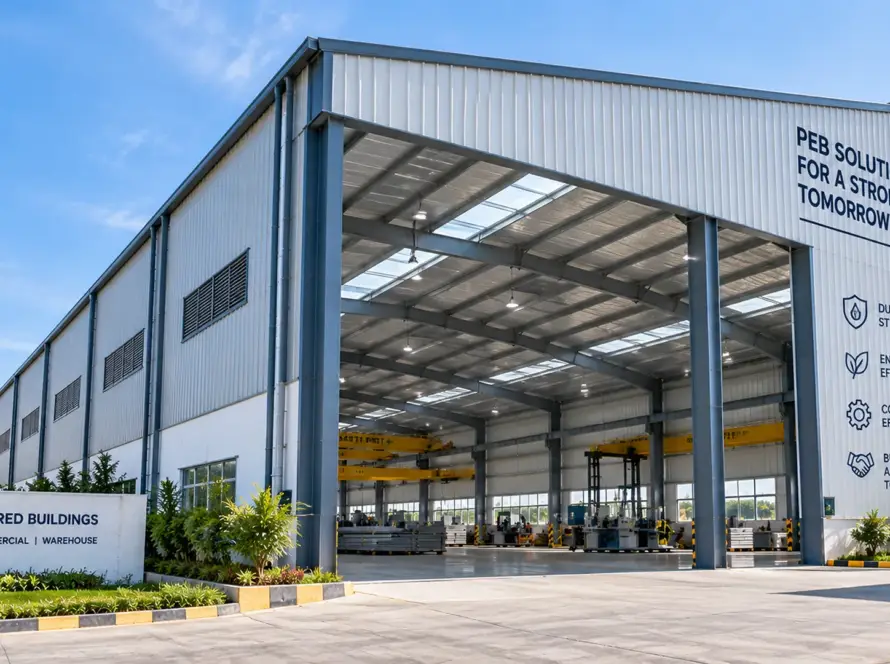
Why does this matter if you’re not FCI? Because it signals where the whole sector is heading. Modern steel construction is being recognized as the more reliable, longer-term way to store grain compared to older infrastructure. Private agribusinesses, cooperatives, and processors don’t have to wait for government projects to benefit from the same shift — a well-designed PEB for agro-processing and grain storage units gets you the same core advantages: durability, moisture protection, and much faster construction than waiting on public infrastructure rollouts.
Why PEB Is the Right Structural Choice for Agri-Applications
Speed of Construction Around Harvest Cycles
Timing matters enormously in agriculture. If your storage or processing facility isn’t ready before harvest season, you’re stuck with makeshift arrangements that risk spoilage and losses. PEB structures are fabricated off-site while foundation work happens in parallel, which cuts construction time significantly compared to conventional brick-and-mortar or RCC building. That difference can be the gap between having a facility ready in time for the season or missing it entirely.
Cost and Material Efficiency
PEB structures use engineered steel sections designed specifically for the load they need to carry — nothing more. Studies comparing pre-engineered buildings with conventional steel buildings have found meaningful reductions in steel weight, including lighter purlins and girts, without compromising structural strength. In practical terms, this means less material waste and a more cost-efficient build for the same storage or processing capacity.
Durability Against Weather, Pests, and Corrosion
A well-built PEB uses galvanized steel and a sealed building envelope, which holds up well against monsoon humidity, temperature swings, and pest intrusion — all real risks for anything storing or processing grain in India. Compared to older storage methods, a sealed steel structure gives you a much longer service life with far less maintenance.
What IS 800:2007 Compliance Actually Means for Your Structure
If you’ve spoken to more than one PEB vendor, you’ve probably heard the term “IS 800:2007” thrown around. It sounds technical, and most content either ignores it completely or buries it in engineering jargon. Here’s what it actually means for you as a buyer.
IS 800:2007 is the Indian code that governs structural steel design — essentially, the rulebook that determines how a steel building should be engineered to safely handle load, wind, and seismic forces. For a grain storage or processing building, this isn’t just paperwork. It’s what stands between your structure and real risks: a roof that can’t handle the load of dust and debris buildup, a wide-span roof that lifts under strong wind, or a structure that isn’t accounted for regional seismic activity.
You don’t need to understand the calculations yourself. But asking your PEB vendor directly — “Is this structure designed and certified to IS 800:2007?” — is a completely fair and simple question, and the answer tells you a lot about whether you’re dealing with a vendor who engineers properly or one who’s cutting corners on design to save cost.
Design Essentials for Grain Storage PEBs
Moisture and Pest Control
This is the single biggest factor in preventing spoilage. Insulated panel options like PUF, EPS, or rock wool help regulate internal temperature and reduce condensation, which is one of the main causes of grain damage in storage. Joints and seams need to be properly sealed — not just for weatherproofing, but because any gap is a potential entry point for pests.
Load-Bearing and Floor Design
Bulk or stacked grain puts sustained pressure on flooring, so the floor and foundation need to be designed for that specific load, not a generic industrial spec. This is something worth discussing directly with your builder based on your expected storage volume and grain type.
Ventilation and Temperature Management
Gujarat’s climate brings both intense heat and monsoon humidity, and grain storage needs to handle both without letting moisture build up inside. Depending on the facility size and location, this might mean passive ventilation (roof vents, louvers) or mechanical systems for tighter climate control. The right choice depends on your storage volume and how long grain typically sits before it moves out.
Design Essentials for Agro-Processing PEBs
Hygiene and Compliance Layout
Processing facilities need washable, easy-to-clean wall and floor finishes, proper drainage slopes to avoid water pooling, and a layout that supports the kind of hygiene standards expected in food-grade processing. This isn’t optional if your output is headed for retail or export markets.
Equipment Flow and Clear-Span Requirements
Milling, sorting, and packaging lines need open floor space without support columns interrupting the layout. PEB’s clear-span design is a genuine advantage here, since it lets you plan equipment placement and movement without working around structural obstructions. Door sizing also matters — machinery and material handling equipment need enough clearance to move in and out easily.
Utility and Service Integration
A processing unit needs power capacity planned around your actual machinery load, water access, and proper drainage — and ideally, some room built in for future expansion. Retrofitting utilities into a structure after the fact is far more expensive than planning for them upfront.
Gujarat’s Agro-Processing Landscape — Why Local Context Matters
Gujarat’s agricultural economy isn’t generic — it has its own specific processing needs. Cotton ginning is a major activity across the state, along with groundnut and cumin processing, and the state has a strong network of grain mandis handling produce across regions. Anyone sourcing PEB for agro-processing and grain storage units in Gujarat is working with a different set of practical considerations than a wheat storage facility in Punjab or a dairy plant elsewhere in the country.
Local wind and seismic zone factors also come into play in structural design, and they vary by region. Working with a PEB provider that understands Gujarat’s specific conditions — and can deliver and erect the structure quickly within the region — makes a real difference compared to relying on a generic national template.
Cost Factors and Realistic Timelines
PEB pricing depends on a handful of practical factors: the clear-span width you need, building height, the level of insulation, flooring specification, and how much utility fit-out is required. A basic grain storage shed will cost less than a fully fitted processing unit with hygiene finishes and utility integration.
On timelines, PEB construction is considerably faster than conventional building methods, since fabrication happens off-site while foundation work is underway. The exact timeline depends on structure size and complexity, but planning your build well ahead of your harvest or procurement cycle is always the safer approach.
FAQs
Grain storage focuses on load capacity, moisture control, and pest protection with minimal internal activity. A processing unit needs hygienic finishes, open floor space for equipment, and proper utility integration for machinery and staff movement.
This depends entirely on your equipment layout — milling and sorting lines need enough open width to avoid support columns interrupting the flow. It’s best discussed with your PEB designer against your specific machinery plan.
It should, if designed properly. Always confirm directly with your vendor that the structure is engineered and certified to IS 800:2007 and accounts for your region’s wind and seismic zone.
PEB construction is significantly faster than conventional RCC building because steel fabrication happens off-site while foundation work proceeds in parallel. Exact timelines vary with size and complexity, so it’s worth confirming early with your builder.
Yes, this is possible with the right planning — but it needs to be decided at the design stage, since storage and processing zones have different flooring, hygiene, and utility requirements.
Why Choose Devashish Infrastructure
Devashish Infrastructure designs and manufactures PEB for agro-processing and grain storage units across Gujarat, with a focus on getting the engineering right for each specific use case rather than offering a one-size-fits-all template.
From compliant structural design to fast regional delivery and erection, the goal is a facility that’s ready when your season demands it. If you’re planning a storage or processing structure, get in touch to discuss your span, capacity, and site requirements.