A metal-roofed shed can feel like an oven by noon. The roof sheets soak up the sun, and the hot air, fumes and moisture stay trapped right under them. A ridge vent in PEB buildings is the simplest passive fix for this. It lets hot air leave through the highest point of the roof, with no power and almost no running cost. In this guide, we’ll cover how it works, which type to choose and how to size it for your shed.
What Is a Ridge Vent in a PEB?
A ridge vent in a PEB is an opening along the roof ridge, covered by a weatherproof cap, that lets hot air escape naturally. It sits at the highest point of the roof and runs along the building length. Because warm air rises, the vent gives it an easy way out, while the cap keeps rain and birds from getting in.
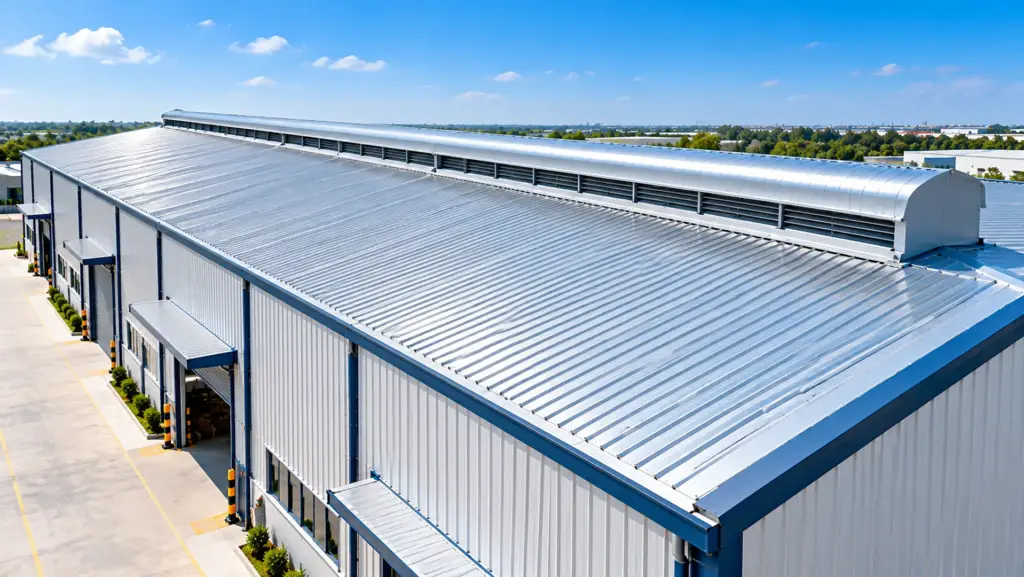
You can place it in two ways. A continuous vent runs along most of the ridge, while intermittent (segmented) vents are installed as separate units with gaps between them. Continuous vents move more air, and segmented ones suit buildings with crane beams or roof equipment in the way.
How Does a Ridge Vent Work?
The idea is simple, and it needs no electricity. Once you see the airflow path, the rest of the design becomes much easier to understand.
The Stack Effect
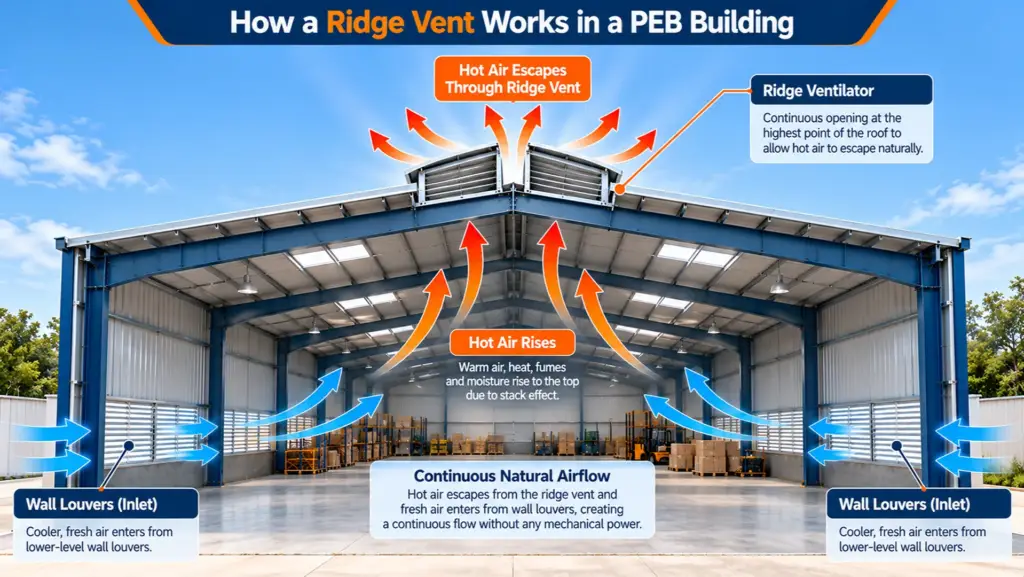
Hot air is lighter than cool air, so it rises and collects under the roof. The ridge vent lets it out at the top. As it leaves, cooler air is drawn in lower down, and the cycle repeats all day. On a still summer afternoon, this slow upward drift is often the only airflow a closed shed gets, which is why a ridge vent in PEB roofs pays off so quickly.
Why Wall Louvers Matter
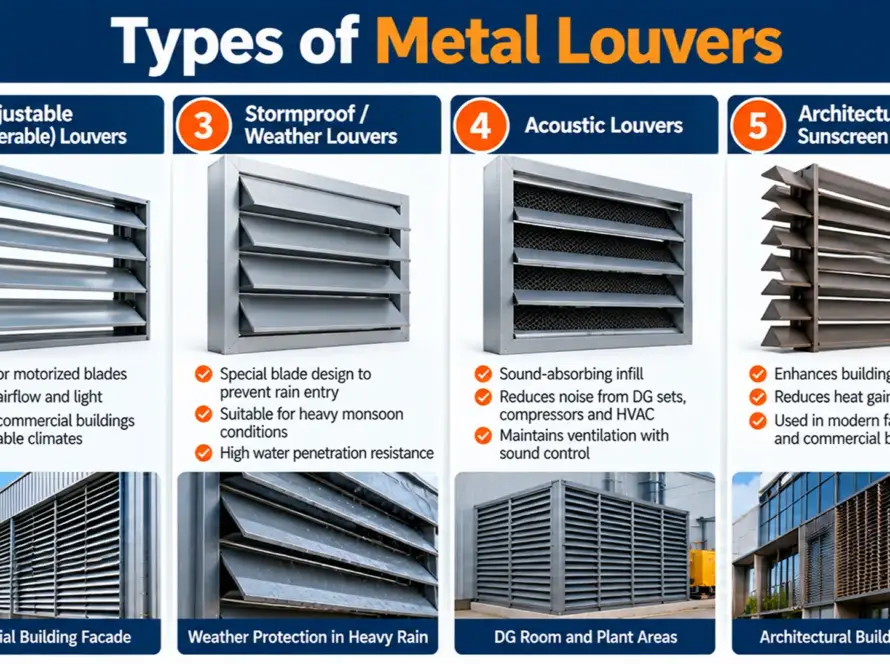
A ridge vent is only the outlet. Without inlet openings at a lower level, airflow stays weak, because air can’t leave if nothing can replace it. That’s why metal louvers on the side walls are part of the same system.
Why PEB Buildings Need Ridge Ventilation
Steel sheds heat up quickly, and a ridge vent in PEB roofs helps in several ways: Heat is also the main reason stock spoils and machines run hotter than they should, so ventilation protects more than comfort.
- Metal roof sheets absorb and radiate heat, and the vent lets that heat out.
- It reduces condensation and roof sweating, which would otherwise drip on stock and machinery.
- It removes fumes, smoke and dust from process areas.
- It improves worker comfort and productivity.
- Passive airflow reduces dependence on exhaust fans, so energy costs come down.
Types of Ridge Vents Used in PEB Buildings
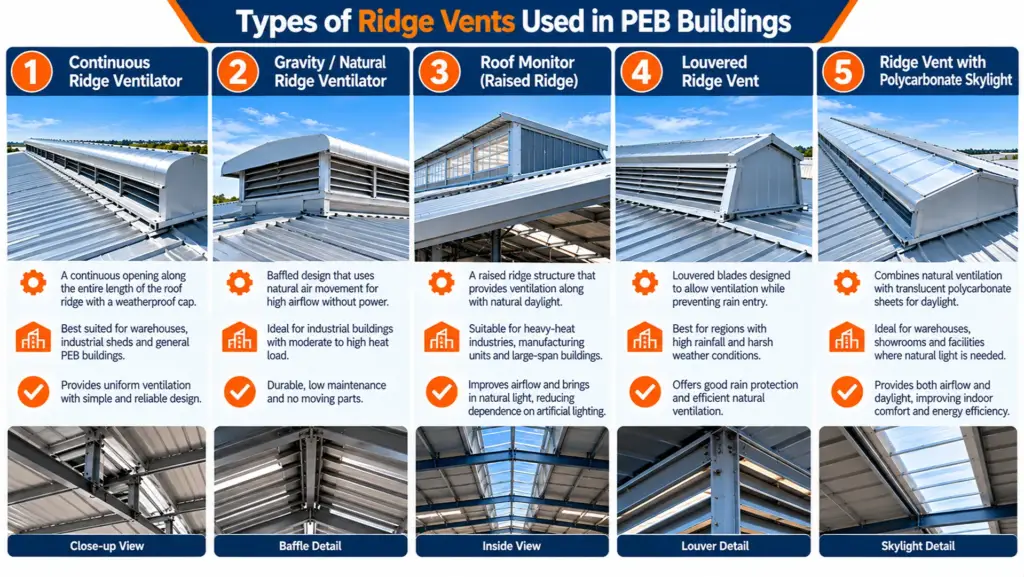
Several designs are in use. Here is how they differ, so you can match one to your shed.
Continuous Ridge Ventilator
This is the most common type for warehouses and general sheds. It runs along the ridge and gives steady, even airflow. Its main advantage is simplicity, since it’s easy to install and needs little upkeep.
Gravity or Natural Ridge Ventilator
This design uses a baffled shape to move a lot of air with no moving parts. It works well where you want strong airflow without power. As a result, running costs stay close to zero.
Roof Monitor (Raised Ridge)
A roof monitor lifts a section of the ridge to add ventilation and daylight together. It suits heavy-heat industries such as foundries and forge shops. The extra height also helps hot air rise out faster.
Louvered Ridge Vent
Louvers control how much rain can enter, so this type suits high-rainfall regions. It keeps airflow open while blocking driven rain. If you work near the coast, that’s a real advantage.
Ridge Vent with Polycarbonate Skylight
This one combines natural light and airflow in a single roof element. It’s a good choice for assembly areas and warehouses where lighting bills are high. You get daylight and ventilation without cutting two separate openings.
Ridge Vent vs Turbo Ventilator vs Exhaust Fan
Each option has its place, and the table below shows how they compare.
| Factor | Ridge Vent | Turbo Ventilator | Exhaust Fan |
|---|---|---|---|
| Airflow type | Natural, stack effect | Wind-driven, with some natural lift | Forced, mechanical |
| Power needed | None | None | Yes |
| Maintenance | Very low | Low, bearings need checks | Higher, motors and belts |
| Noise | Silent | Low | Noticeable |
| Weather resistance | Good with baffles or louvers | Good | Needs weather covers |
| Best for | General sheds and warehouses | Spot heat removal and retrofits | Fume-heavy or high-heat processes |
So when is a ridge vent alone enough? For most warehouses and general sheds, it is. For high-heat or fume-heavy work, though, combine it with industrial ventilators such as turbos, or with fans in the process area.
How to Size a Ridge Vent in a PEB Shed
Sizing decides whether the vent actually works, so it deserves some care.
Factors That Decide Size
Start with the shed length and width, then look at the eave and ridge height. After that, consider the internal heat load from machinery and furnaces, the air changes per hour you need and the number of people working inside. A hot process area needs much more outlet than a storage shed.
Balancing Inlet and Outlet Area
The inlet louver area should match or exceed the ridge outlet area. If the inlet is too small, the vent can’t pull air through, no matter how large it is. Designers use rule-of-thumb ratios for this, but always confirm the figures with your design team.
Final sizing should come from your PEB designer, who knows the loads and layout. If you’d like that done for your shed, talk to our team early in the design stage. In practice, a correctly sized ridge vent in PEB sheds also keeps the roof from overheating, so the interior stays closer to outside temperature.
Design and Material Considerations
A few details make the difference between a vent that lasts and one that leaks.
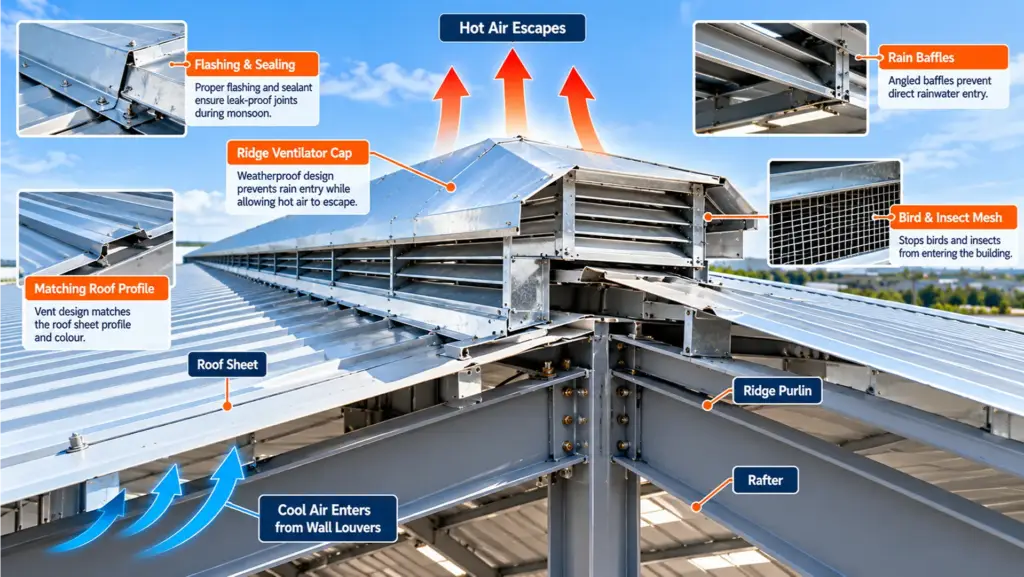
- Materials: Galvalume or PPGI sheet, matched to the roof profile and colour.
- Weatherproofing: rain baffles, end closures and sealant at all joints.
- Bird and insect mesh: keeps pests out without blocking airflow.
- Wind load and fixing: extra attention in coastal or high-wind areas.
Planning the vent at the design stage is far better than retrofitting later, because the frame, sheeting and flashing can all be arranged around it. Coastal sites also need good coatings, which we explain in our guide to anti-corrosion coatings for PEB. For the roof itself, see our notes on roof and wall cladding. Retrofits are possible, but they often mean cutting finished sheets and re-sealing the roof, which adds cost and leak risk.
Where a Ridge Vent in PEB Buildings Works Best
You’ll see it most often in these places:
- Factories and workshops
- Warehouses and logistics hubs, like the ones in our PEB warehouses guide
- Textile and engineering units
- Cold storage anterooms and processing areas, as covered in our cold storage PEB article
- Poultry and agri sheds
We design ventilated sheds for regional clients too, including in Vadodara and Coimbatore.
Common Ridge Vent Mistakes to Avoid
- Choosing an undersized vent for the shed span
- Leaving out inlet louvers, which starves the airflow
- Poor sealing, which causes leaks in the monsoon
- Placing the vent where crane beams or roof equipment block it
- Buying on price alone and ignoring rain protection
Most of these come down to planning. Get the design right once, and the vent will need very little attention afterwards. Ask your manufacturer to show the airflow path on the drawings, from the wall louvers to the ridge. If the path isn’t clear on paper, it won’t work on site.
FAQs on Ridge Vent in PEB
Yes, in most cases. The roof sheets are cut along the ridge and the vent is fitted with proper flashing. Your PEB designer should check the frame and purlin layout first.
A well-designed one does not. Baffles, louvers and end closures keep rain out, while still letting hot air escape. Poor sealing at joints is the usual cause of leaks.
Neither is better in every case. A ridge vent suits general sheds, while turbos help with spot heat or retrofits. Many buildings use both together for stronger airflow.
With coated Galvalume or PPGI sheet and sound sealing, it can last as long as the roof itself. Coastal sites need better coatings and regular checks.
Very little. Check the sealant, fixings and mesh once or twice a year, and clear any dust or debris. There are no motors or moving parts to service.
They can help in anterooms and processing areas, where heat and moisture build up. Inside the insulated cold rooms, though, vents are not used, because they would break the thermal seal.
Conclusion
A ridge vent in PEB buildings is passive, low-cost and effective, as long as it’s paired with correct inlet openings and sized properly. It keeps the shed cooler, the stock drier and the workers more comfortable. To plan a PEB with integrated ventilation, talk to Devashish Infrastructure through our PEB services page or contact us directly.