Step into a factory or warehouse on an Indian summer afternoon, and you’ll feel the problem straight away. Heat, fumes and humidity build up under the roof, and there’s nowhere for them to go. A ridge ventilator solves this with no electricity at all. It sits on the roof ridge and lets hot air leave naturally, so the whole building breathes better. In this guide, we’ll cover the types, how it works, how to size it and what affects the cost.
What Is a Ridge Ventilator?
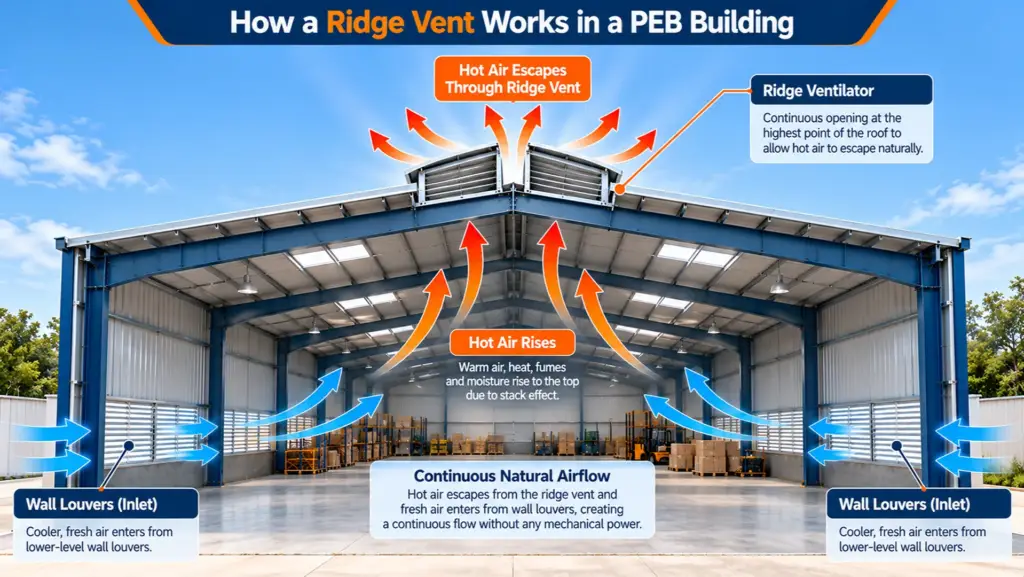
A ridge ventilator is a ventilation opening along the roof ridge that lets hot air escape naturally. It works without power, using the fact that warm air rises. On a pitched or PEB roof, it sits at the very top, where the hottest air collects.
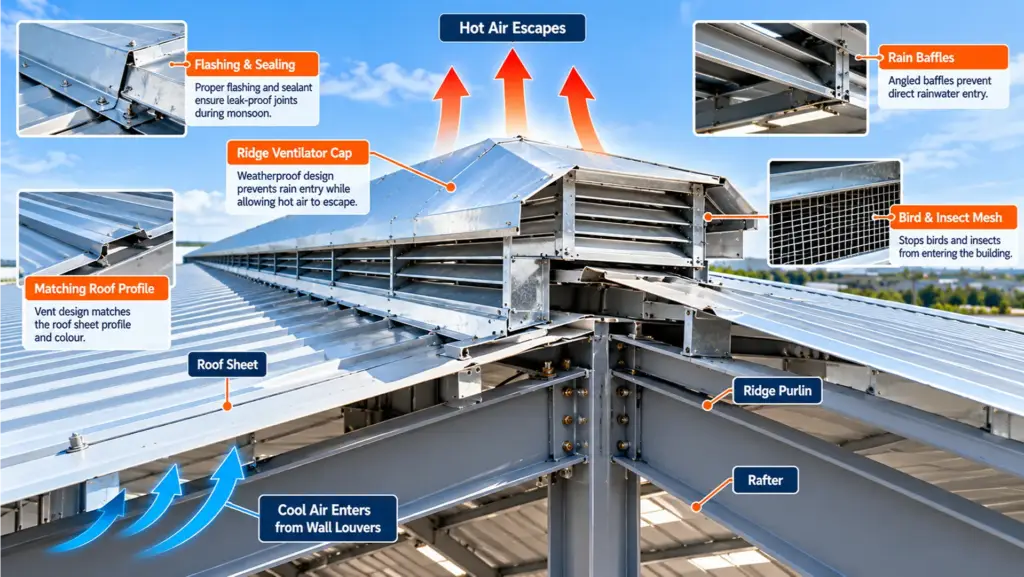
Most units have the same basic build. A weather-protected throat forms the opening, baffles keep rain out, and bird mesh blocks birds and insects. Together, these parts let air out while keeping the weather outside.
How Does a Ridge Ventilator Work?
The principle is simple, and it keeps working all day without any control or switch.
The Stack Effect Explained
Hot air rises to the highest point of the building and exits at the ridge. As it leaves, cooler air is drawn in at the bottom. This steady upward movement is called the stack effect, and it’s what powers every ridge ventilator.
Why Low-Level Air Inlets Matter
A ridge ventilator only works when fresh air can enter lower down. That air can come through louvers, doors or wall vents. Without these inlets, the airflow stalls, no matter how large the ridge opening is. Our guide to metal louvers explains the options for the inlet side.
Types of Ridge Ventilators
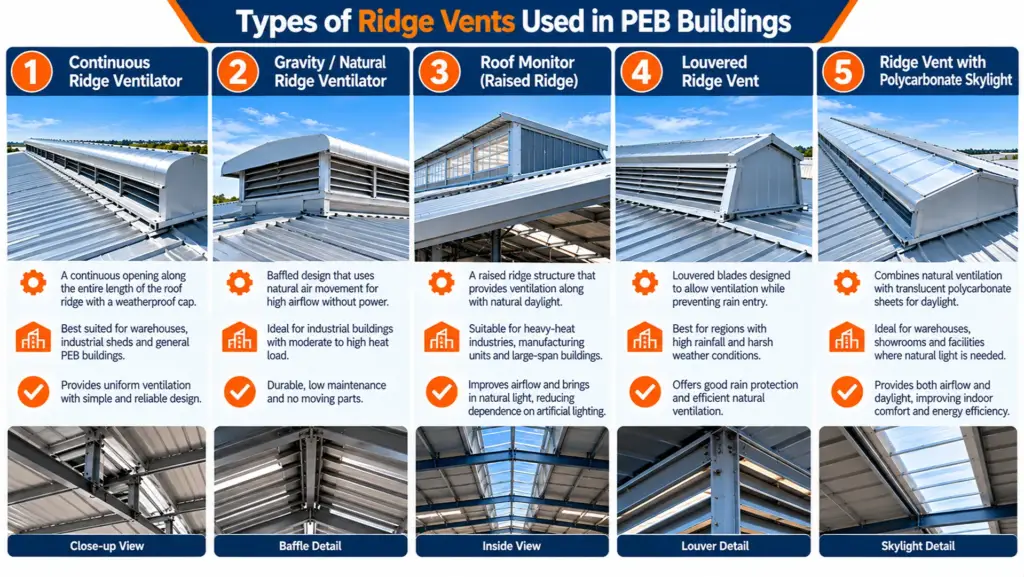
Different buildings need different designs, so here is how the main types compare.
Continuous Ridge Ventilator
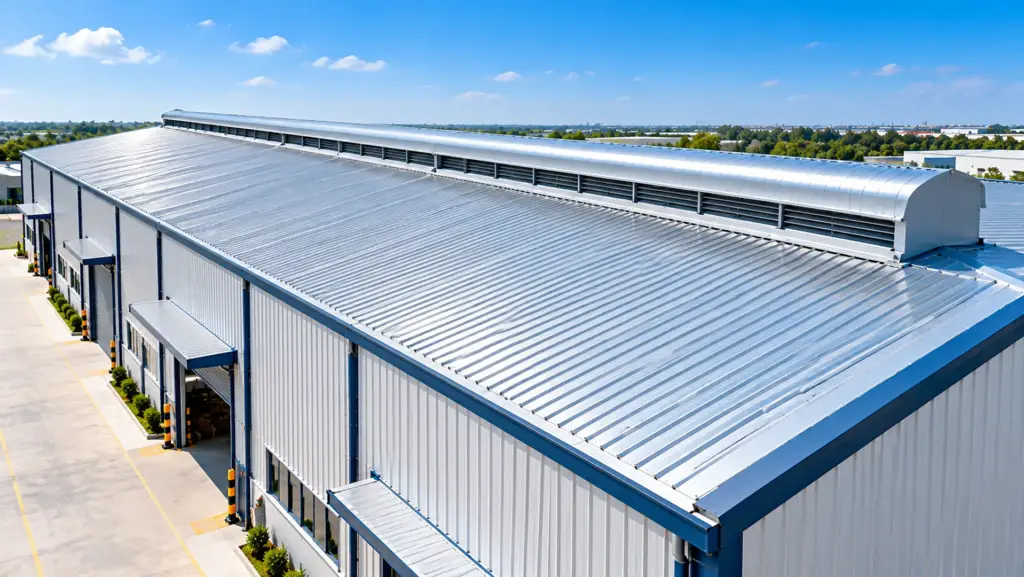
This type runs the full length of the ridge and gives uniform airflow. It’s best for long warehouses and general sheds. Since it’s one long unit, installation is also straightforward.
Modular or Box-Type Ridge Ventilator
These units are installed at intervals along the ridge. They suit retrofits and buildings where you want controlled airflow in certain zones. You can also add more units later as needs grow.
Ridge Monitor (Louvered Roof Monitor)
A ridge monitor is a raised section with side louvers, and it handles very high airflow. You’ll see it in foundries and other units with heavy heat loads. The raised shape helps hot air leave quickly.
Polycarbonate or Daylight Ridge Ventilator
This design combines natural light with ventilation. As a result, it cuts lighting costs in daytime operations. It works well where you want both brightness and airflow from the same roof opening.
Ridge Ventilator vs Turbo Ventilator vs Powered Exhaust
Each option has strengths, and the right choice depends on the building and the process inside it.
| Factor | Ridge Ventilator | Turbo Ventilator | Powered Exhaust |
|---|---|---|---|
| Power consumption | None | None | Continuous while running |
| Airflow consistency | Steady, depends on heat and inlets | Varies with wind | Constant and controllable |
| Maintenance | Very low | Low, bearings need checks | Higher, motors and belts |
| Noise | Silent | Low | Noticeable |
| Rain protection | Good with baffles or louvers | Good | Needs weather covers |
| Lifespan | Long, with coated sheet | Long, bearings wear first | Depends on motor and duty |
| Upfront cost | Low to moderate | Low | Higher, plus running cost |
Honestly, a ridge ventilator alone is enough for most warehouses and general sheds. Turbo ventilators help with spot heat and retrofits, and powered exhaust is the right call when fumes must be removed quickly. In many buildings, a mix works best. See our overview of industrial ventilators for the full range.
Key Benefits of Ridge Ventilators
- Lower indoor temperature and better worker comfort
- Removal of fumes, smoke, dust and moisture
- Zero electricity and no running cost
- Less condensation and corrosion on the roof sheets
- Few moving parts, so maintenance stays low
In short, a ridge ventilator protects people, stock and the building itself.
Where Are Ridge Ventilators Used?
- Warehouses and logistics hubs, such as those in our PEB warehouses guide
- Foundries, forging and steel units
- Textile, chemical and engineering plants
- Workshops, poultry sheds and agricultural storage
How Many Ridge Ventilators Do You Need?
This question decides whether the ventilation works, so it’s worth doing with care.
The Basic Sizing Formula
Start with this: required airflow equals building volume multiplied by air changes per hour (ACH). A general warehouse needs fewer air changes than a high-heat process area, so the ACH value depends on the application. Then divide the required airflow by the ventilator’s rated capacity per running metre, or per unit, to find the length or number you need.
[VERIFY: typical ACH ranges for a general warehouse and a high-heat process area with Devashish’s engineering team or a standard before publishing.]
Worked Example
Take a PEB warehouse that is 60 m long, 30 m wide and 9 m high. The numbers below are for illustration only.
- Volume = 60 × 30 × 9 = 16,200 m³
- Assumed ACH = 10 (illustrative), so airflow needed = 16,200 × 10 = 162,000 m³ per hour
- Assumed rated capacity = 3,000 m³ per hour per running metre (illustrative, check the manufacturer’s data)
- Ridge length needed = 162,000 ÷ 3,000 = 54 m
So in this example, a continuous ridge ventilator along most of the 60 m ridge would do the job. However, heat load, wind and inlet area all change the result. For that reason, ask a professional to assess your building. You can also read our companion guide on a ridge vent in PEB buildings for more on inlets and layout.
Materials and Technical Specifications
- Sheet material: Galvalume, PPGI or aluminium. Aluminium resists corrosion well, while coated steel is usually more economical.
- Throat width and height: a wider and taller throat lets more air through, so it directly affects performance.
- Weather baffles: these keep rain out during the monsoon.
- Bird and insect mesh: keeps pests out without blocking airflow.
- Wind resistance and fastening: check these closely in exposed or coastal sites.
For coastal sites, coatings matter as much as the shape. Our guide to anti-corrosion coatings for PEB covers that in detail, and our notes on roof and wall cladding help you match the ventilator to the roof sheet.
Installation on PEB Roofs and Mistakes to Avoid
Installing During Construction vs Retrofitting
Planning the ridge ventilator at the design stage costs less and leaks less, because the roof can be built around it. Retrofitting is possible, but it means cutting the ridge, fitting new flashing and sealing every joint with care.
Common Mistakes
- Undersizing the ventilation
- Poor flashing, which causes monsoon leaks
- No low-level air inlets
- Choosing the wrong type for dusty or corrosive environments
Ridge Ventilator Price: What Affects the Cost?
Instead of a fixed figure, it helps to know what moves the price:
- Type and design
- Running length or number of units
- Material and coating
- New build versus retrofit
- Labour and roof height
Because every roof is different, the best way to get an accurate number is to request a site-specific quote.
FAQs on Ridge Ventilator
Yes. A ridge ventilator relies on the stack effect, where hot air rises, so it works even on still days. Wind can help, but it isn’t required.
It depends on the building. A ridge ventilator suits long, general-purpose sheds, while turbos help with spot heat and retrofits. Many buildings combine both for better airflow.
A well-made one doesn’t. Baffles, proper flashing and sealed joints keep rain out. Leaks usually come from poor installation, not from the design itself.
With coated Galvalume, PPGI or aluminium sheet and sound sealing, it can last as long as the roof. Coastal and corrosive sites need stronger coatings.
Yes. The ridge is cut, and the unit is fitted with new flashing and sealant. Check the purlin layout first, and make sure low-level inlets are also in place.
Conclusion
A correctly sized ridge ventilator is one of the most cost-effective ways to cool an industrial building. It needs no power, very little upkeep and the right inlets to work well. To get started, request a free ventilation assessment or a PEB and ventilation package quote through our contact page. We serve clients in Vadodara, Coimbatore and across India.